
TL;DR — Quick Summary
A personal injury lawyer is a civil attorney who represents people hurt because someone else was careless — in a car crash, a fall, a dog bite, a defective product. They investigate the accident, prove who is at fault, put a value on your losses, deal with the insurance company and, if needed, sue. Most work on a contingency fee: no upfront cost, and they are paid a share of what they recover. They do not handle criminal charges, and they never represent the insurance company against you.
What is a personal injury lawyer? It is a lawyer whose job is to get injured people paid by whoever caused the injury — usually through that person’s insurance company. The work is civil, not criminal: nobody goes to jail because of a personal injury case. The only question is money, and how much of it you are owed.
That sounds simple. In practice it means proving fault, documenting every loss, and negotiating against an adjuster whose job is to pay as little as possible.
What Is a Personal Injury Lawyer, Exactly?
“Personal injury” is the everyday name for a branch of tort law — the law of civil wrongs. If someone’s carelessness (negligence) or intentional act causes you physical or psychological harm, tort law lets you claim compensation from them.
A personal injury lawyer, also called a personal injury attorney (in the US the two words mean the same thing), represents the injured person — the plaintiff. Lawyers who represent the other side are called defense attorneys, and they are usually hired and paid by insurance companies.
Most personal injury lawyers do not charge by the hour. They take cases on a contingency fee, which is why people with no savings can still hire one the week after an accident.
What Do Personal Injury Lawyers Do? The Work, Stage by Stage
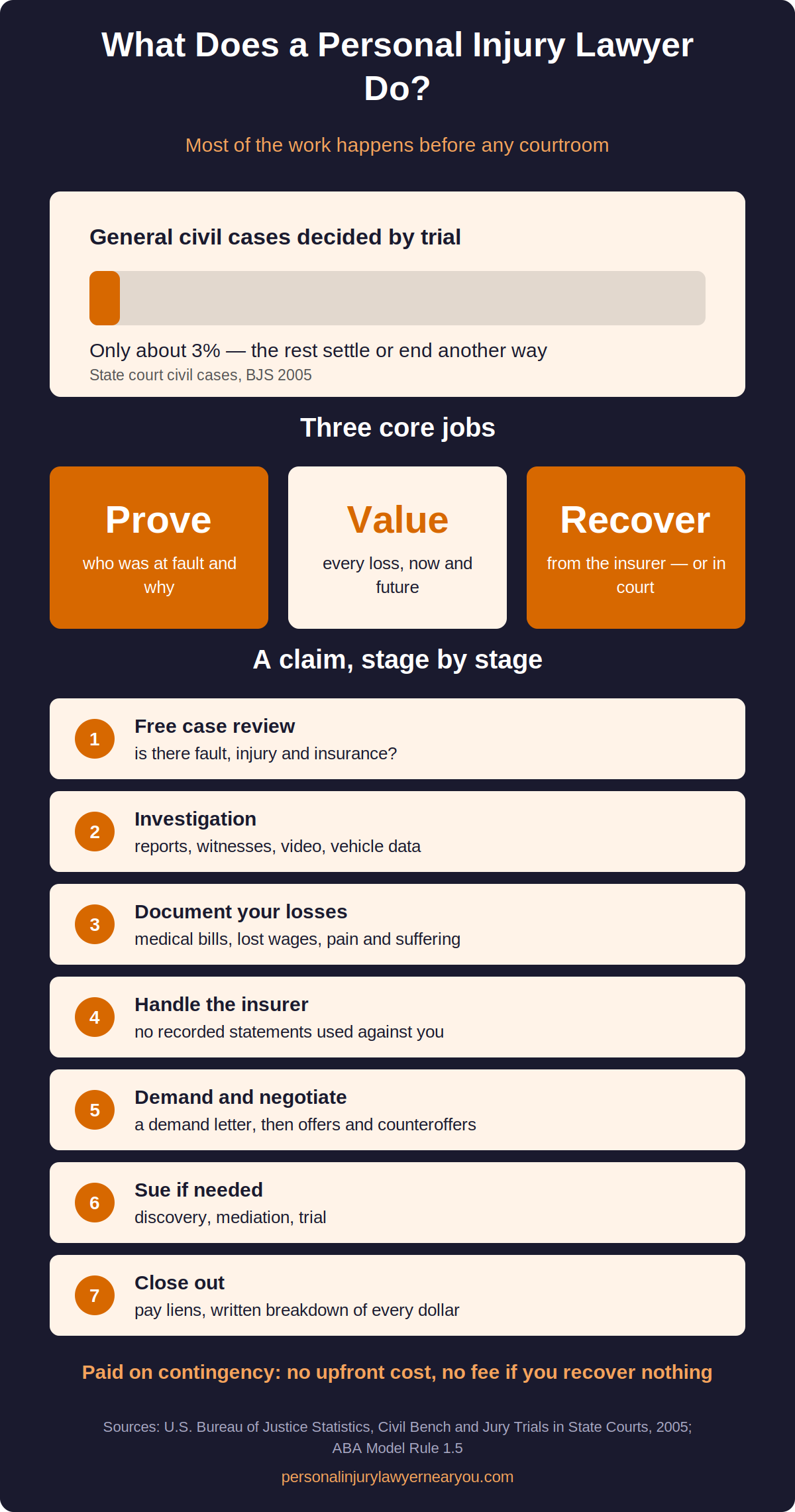
Most of the job happens long before anyone sees a courtroom.
- Free case review. They decide whether you have a claim worth bringing: was someone else at fault, are you actually hurt, and is there insurance to pay it.
- Investigation. Police reports, photos, witness statements, surveillance and dashcam footage, and in truck cases, electronic driving data — before it is deleted.
- Proving fault. Building the legal argument that the other party had a duty of care, broke it, and that this caused your injury.
- Documenting your losses. Medical records and bills, lost wages, future treatment, and the harder-to-price losses like pain and suffering.
- Handling the insurance company. All calls, recorded statements and paperwork go through them, so nothing you say gets used to cut your claim.
- Demand and negotiation. A demand letter sets out the case and the number; then the back-and-forth with the adjuster begins.
- Filing a lawsuit if needed. If the offer is too low or the deadline is close, they file suit, handle discovery and depositions, and take the case to mediation or trial.
- Closing out. Paying medical liens from the settlement and sending you a written breakdown of where every dollar went.
Trials are the exception, not the rule. A Bureau of Justice Statistics study of state courts found that trials accounted for only about 3% of general civil case outcomes — the rest settle or end some other way. A good personal injury lawyer prepares every case as if it will go to trial, because that is what moves the insurer.
What Cases Do Personal Injury Lawyers Take?
| Case type | Typical example |
|---|---|
| Motor vehicle accidents | Car, truck, motorcycle, rideshare, bus and pedestrian crashes |
| Premises liability | Slip and fall on a wet store floor, broken stairs, unsafe sidewalks |
| Construction and workplace | Falls from scaffolds, injuries caused by a third party on a job site |
| Dog bites | Attacks by a neighbour’s or stranger’s dog |
| Defective products | Faulty car parts, exploding devices, dangerous drugs |
| Medical malpractice | Surgical errors, misdiagnosis — often handled by specialist firms |
| Wrongful death | A family’s claim when an accident is fatal |
Many lawyers specialise further — some only take truck crashes, others only medical malpractice. You can see the main claim types we cover on our practice areas page.
What Can a Personal Injury Lawyer Get You?
The lawyer’s job is to recover every category of loss the law allows, not just the bills in front of you. That usually includes:
- Medical expenses — past and future, including therapy and medication
- Lost income — wages already missed and reduced earning ability later
- Pain and suffering — physical pain, emotional distress and loss of enjoyment of life
- Property damage — your vehicle and personal items
- Punitive damages — rare, and only where the conduct was especially reckless
Our guide to the types of damages in a personal injury claim goes through each one in detail. For a rough number, the personal injury settlement calculator gives a starting range in under a minute.
How Personal Injury Lawyers Get Paid
Under a contingency fee, the lawyer takes an agreed percentage of the settlement or verdict — commonly around a third, often more if the case goes to trial. If you recover nothing, you owe no fee.
The agreement must be put on paper. Under the ABA Model Rule 1.5, which most states follow, a contingent fee agreement has to be in writing, signed by the client, and must spell out the percentage at each stage and how case expenses are handled. At the end, the lawyer has to give you a written statement showing how the money was split.
Read the expenses clause closely. Court fees, expert reports and medical records cost money, and whether those come out before or after the lawyer’s percentage changes what lands in your account.
Personal Injury Lawyer vs Other Lawyers
| Lawyer | Who they represent | How they are usually paid |
|---|---|---|
| Personal injury lawyer | The injured person | Contingency fee |
| Insurance defense lawyer | The at-fault party and their insurer | Hourly, paid by the insurer |
| Criminal defense lawyer | A person charged with a crime | Flat or hourly fee — contingency is not allowed |
| Workers’ comp lawyer | An employee hurt at work | Fee often set or approved by a state board |
One accident can involve more than one of these. A drunk driver who hits you may face a criminal case brought by the state and a separate personal injury claim brought by you — and the outcome of one does not decide the other.
When Should You Talk to One?
Not every bump needs a lawyer. A minor injury that heals in days, with the other insurer paying your bills promptly, can often be handled alone. Call one when any of these apply:
- Your injury needs ongoing treatment, surgery, or keeps you off work
- Fault is disputed, or more than one party may be responsible
- The insurer is asking for a recorded statement or offering a quick settlement
- A government body, employer or commercial vehicle is involved
- A filing deadline is getting close
The first meeting is free, and it is worth knowing what happens at a personal injury consultation before you go. If you are still choosing who to call, our guide on how to find a personal injury lawyer covers the questions that separate a good one from a settlement mill.
What Is a Personal Injury Lawyer Not Allowed to Do?
Understanding what is a personal injury lawyer’s role also means knowing the limits. Lawyers are bound by professional conduct rules, and a few of them protect you directly.
- They cannot settle without your consent. The decision to accept or reject an offer belongs to you, not the lawyer. They can advise you, but they must tell you about offers and follow your decision.
- They cannot guarantee a result. A lawyer can give you an honest estimate. A promise of a specific dollar amount is a red flag.
- They generally cannot give you money to live on. Lawyers may advance case costs such as filing fees and expert reports, but rules generally prohibit them from paying your rent or living expenses while the case is pending.
- They cannot represent both sides. A personal injury lawyer will not also represent the driver or company that injured you.
- They must keep your money separate. Settlement funds go into a client trust account, not the firm’s operating account, until liens, fees and your share are paid out.
What a good one does that is not in any rule
Beyond the rules, the best lawyers return calls, explain each stage before it happens, and tell you plainly when an offer is fair — even if that means a smaller fee for them. If you are wondering what is a personal injury lawyer worth paying for, it is that judgment: knowing when to push, when to settle, and saying so honestly.
If a lawyer you meet promises a number, pressures you to sign on the spot, or offers to cover your bills while you wait, treat it as a warning sign and get a second opinion before you commit.
Frequently Asked Questions
What is a personal injury lawyer in simple terms?
A personal injury lawyer is a civil attorney who represents people injured because someone else was careless. They prove who was at fault, calculate your losses and get compensation from the at-fault party or their insurance company.
What does a personal injury lawyer do day to day?
Most of the work is investigation, gathering medical records, valuing claims and negotiating with insurance adjusters. Only a small share of cases ever reach trial, so much of a personal injury lawyer’s time is spent building a case strong enough to settle.
Is a personal injury attorney the same as a personal injury lawyer?
Yes. In the United States, lawyer and attorney are used interchangeably. Both refer to someone licensed by a state bar to practise law and represent clients.
How much does a personal injury lawyer cost?
Most charge nothing upfront and work on a contingency fee, commonly around a third of the recovery and often more if the case goes to trial. If you recover nothing, you owe no fee. The agreement must be in writing and signed by you.
Do personal injury lawyers handle criminal cases?
No. Personal injury is civil law and is about compensation. If the person who hurt you is charged with a crime, that case is brought by the state, and your personal injury claim runs separately.
What cases do personal injury lawyers not take?
They usually turn down cases where nobody else was at fault, where the injury is very minor, or where there is no insurance or assets to pay a claim. Many also refer medical malpractice and complex product cases to specialist firms.
Key Takeaways
✅ A personal injury lawyer represents the injured person, never the insurer
✅ The job is mostly investigation, valuation and negotiation — trials are rare
✅ Most work on contingency: no upfront cost, no fee if you lose
✅ The fee agreement must be in writing and signed by you
✅ Call one when injuries are serious, fault is disputed, or a deadline is near
The Other Side Already Has a Lawyer
From the day of the accident, the insurance company has adjusters and defense counsel working out how little it can pay. A personal injury lawyer exists to level that. A case review costs nothing, and it tells you whether you have a claim, what it might be worth, and how long you have to act.
Hurt in an Accident? Find Out If You Have a Case
Free case review. No win, no fee. No upfront cost.
Want more NYC injury guides and legal news from PILNY in your Google results?
