
TL;DR — Quick Summary
Nobody can give you a number from a web page, and anyone who does is guessing. What they can tell you is what decides it — and in New York that changed on 26 May 2026. Two gates now sit in front of any pain-and-suffering recovery: you must clear the serious injury threshold, which lost a whole category, and your own share of fault must not exceed the defendants’ combined share, or non-economic damages disappear entirely. On Staten Island a third factor applies that exists almost nowhere else — who the defendant is changes the value, because one of them means no jury at all.
Everyone asks what a Staten Island truck accident settlement is worth, and every honest answer starts the same way: not from a web page.
That is not evasion. It is that two claims with identical injuries can be worth wildly different amounts depending on facts that have nothing to do with the injuries — and since May 2026, two of those facts are new.
Gate One: The Serious Injury Threshold Got Narrower
New York is a no-fault state. Your own insurer covers medical bills and lost earnings up to the policy limit regardless of fault — but you cannot sue for pain and suffering unless your injury meets the statutory definition of a “serious injury” under Insurance Law § 5102(d).
That definition used to include a 90/180-day category, which allowed recovery where an injury prevented substantially all of your usual daily activities for at least 90 of the first 180 days after the crash. It was the route for people with genuine but temporary injuries — the ones that hurt badly for months and then resolved.
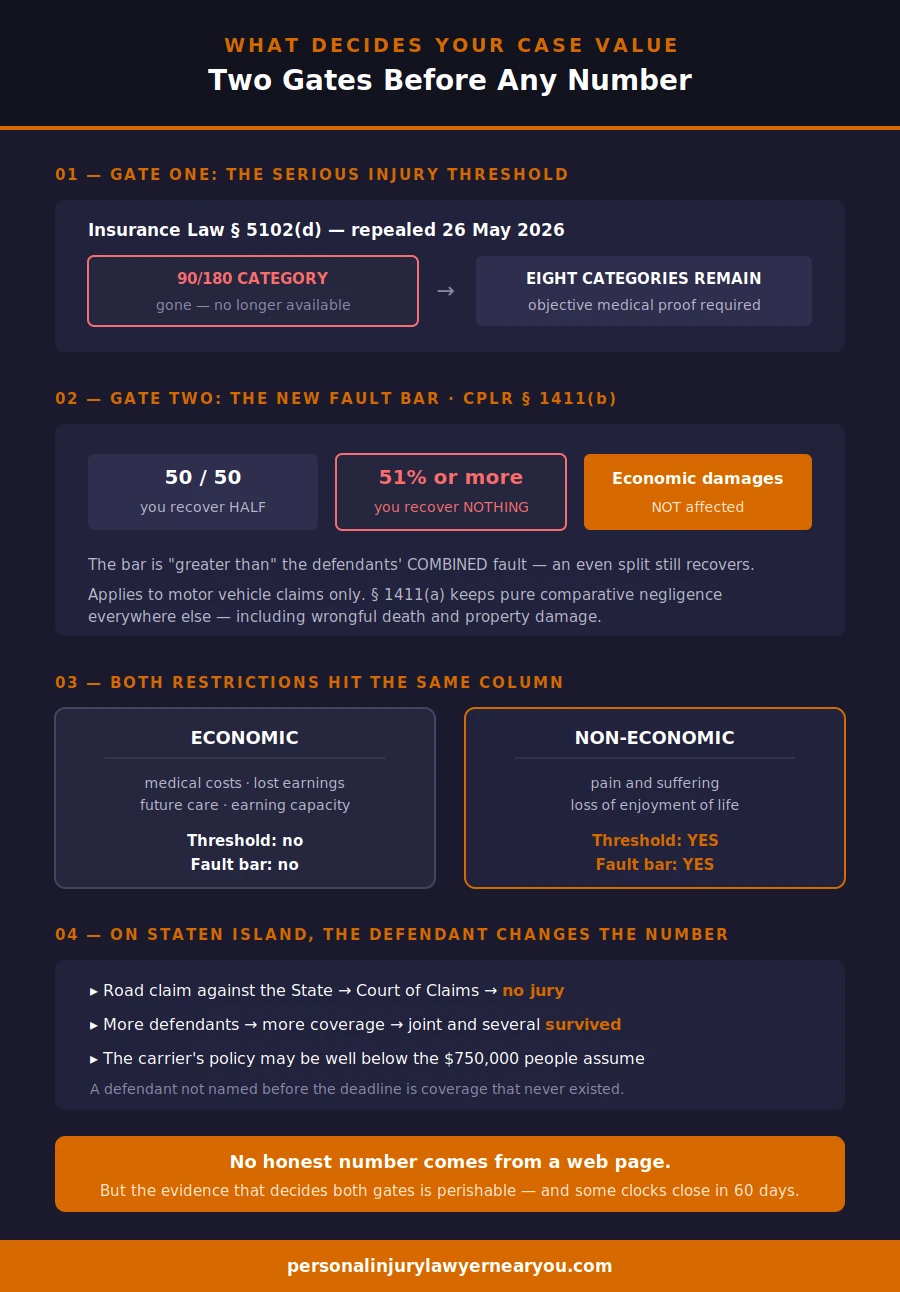
Part EE of Chapter 58 of the Laws of 2026 repealed it, for actions filed on or after 26 May 2026. Eight categories remain. A soft-tissue injury that eventually resolves must now qualify under a category such as significant limitation of use, supported by objective medical evidence, or it does not clear the threshold at all.
The practical consequence is blunt: objective documentation from the first week now decides whether pain and suffering is available at all. Imaging, measured range-of-motion testing, consistent treatment records. Not how much it hurt — what can be proved.
Gate Two: Your Own Share of Fault Can Erase It
For fifty years New York applied pure comparative negligence. A plaintiff 99 percent at fault still recovered 1 percent. That is no longer true for motor vehicle claims.
The same 2026 legislation added CPLR § 1411(b), which applies to personal injury actions under Insurance Law Article 51. Where your culpable conduct is greater than the combined culpable conduct of the defendants, you recover no non-economic damages.
Three things about that are worth getting right, because they are commonly misstated:
- An even split still recovers. The bar applies where your share is greater than the defendants’ combined share. At 50/50 you recover half of your non-economic damages. At 51 percent you recover none.
- It only affects non-economic damages. Economic losses — medical costs, lost earnings, future care — are not barred by this provision.
- It only applies to motor vehicle claims. CPLR § 1411(a) keeps pure comparative negligence for everything else, including property damage and wrongful death actions.
There is also a new $100,000 cap on non-economic damages under Insurance Law § 5104(d), but it is narrow — it applies to an at-fault claimant who was uninsured, convicted of an impaired driving offence, or convicted of a felony connected to the crash. It will not touch most claims.
One further change matters at trial: juries now determine fault allocation before reaching the threshold question. Defence analysis of the reform has noted this makes accident reconstruction and black box evidence more central than before, a point covered in a defence-side review of the 2026 reforms.
What Changed, and What It Means for Value
| Change | What it says | Effect on value |
|---|---|---|
| 90/180 category repealed Ins. Law § 5102(d) |
Eight threshold categories remain; the temporary-disability route is gone | Some claims that previously had pain-and-suffering value now have none |
| Fault bar added CPLR § 1411(b) |
No non-economic damages where your fault exceeds the defendants’ combined fault | Contested-liability cases are worth materially less than before |
| Narrow damages cap Ins. Law § 5104(d) |
$100,000 cap for at-fault claimants who were uninsured or convicted of impaired driving or a connected felony | Affects a small subset of claimants only |
| Fault decided first | Juries allocate fault before reaching the threshold question | Reconstruction and black box evidence carry more weight |
| Joint and several preserved | The widely reported repeal did not pass | Multi-defendant cases keep an important advantage |
That last row matters more on Staten Island than most places, because these cases routinely have several defendants — which is where the third factor comes in.
Who the Defendant Is Changes the Number
This is the part that is specific to here, and it is rarely discussed.
Staten Island’s truck corridors are owned by five different bodies, set out in our guide to which authority owns the road you crashed on. That affects deadlines — but it also affects value, in three ways.
- No jury against the State. A road-condition claim arising on the Staten Island Expressway goes to the Court of Claims, where a judge decides damages rather than a jury. That is a materially different valuation environment, covered in our post on Staten Island Expressway crashes.
- More defendants means more coverage. A truck, a chassis owner, a road authority and a shipper each carry separate insurance. With joint and several liability preserved, adding defendants does more than spread blame.
- The carrier’s policy may be smaller than assumed. The federal $750,000 minimum does not apply to every truck, as set out in our breakdown of when that minimum does not apply.
A claim where the only defendant is a small local carrier with a modest policy is worth what that policy holds, however severe the injuries. A claim with four defendants and layered coverage is a different proposition entirely.
The Two Kinds of Damages
| Economic | Non-economic | |
|---|---|---|
| What it covers | Medical costs, lost earnings, future care, future earning capacity | Pain and suffering, loss of enjoyment of life |
| How it is proved | Documents — bills, payslips, expert projections | Medical evidence, testimony, comparable verdicts |
| Threshold applies? | No | Yes — § 5102(d) gates it entirely |
| Fault bar applies? | No | Yes — CPLR § 1411(b) |
Both new restrictions sit on the same column. That is why a case with severe documented economic losses and contested liability behaves very differently now than it did in 2025.
What You Can Control
Most of what decides value is fixed by the time you read this. Three things are not.
- Objective medical documentation, immediately. The threshold now depends on it more than ever. Gaps in treatment are the single most effective argument the other side has.
- Evidence on fault. With fault decided first and a bar attached to it, black box data, camera footage and reconstruction matter more than they did last year — and they are perishable.
- Identifying every defendant before the shortest deadline closes. A defendant not named is coverage not available, and on Staten Island some of those windows close in 60 or 90 days.
Our free personal injury settlement calculator gives you a working range to reason about, not a valuation — and it is worth running before responding to any offer.
Frequently Asked Questions
What is the average Staten Island truck accident settlement?
There is no meaningful average, and figures presented as one are marketing rather than analysis. Value turns on the severity and permanence of the injury, documented economic losses, the allocation of fault, the coverage actually available across all defendants, and whether the case is heard by a jury or a judge. Two claims with identical injuries can differ enormously on those factors alone.
What is the 90/180 rule and is it gone?
It was a category of the serious injury threshold allowing recovery where an injury prevented substantially all customary daily activities for at least 90 of the first 180 days after a crash. Part EE of Chapter 58 of the Laws of 2026 repealed it for actions filed on or after 26 May 2026, leaving eight categories. Injuries that once qualified that way must now meet another category with objective medical support.
If I was partly at fault, can I still recover?
Yes, within limits. Under CPLR § 1411(b), non-economic damages are barred where your culpable conduct is greater than the defendants’ combined culpable conduct. At an even 50/50 split you recover half of your non-economic damages; above that you recover none. Economic damages such as medical costs and lost earnings are not barred by this provision.
Is New York still a pure comparative negligence state?
Generally yes. CPLR § 1411(a) retains pure comparative negligence for most claims, including property damage and wrongful death. The 2026 reform created a targeted carve-out in new subsection (b) applying only to motor vehicle personal injury actions subject to Insurance Law Article 51.
Does the new $100,000 cap apply to me?
Probably not. Insurance Law § 5104(d) caps non-economic damages at $100,000 for an at-fault claimant who was uninsured, convicted of an impaired driving offence, or convicted of a felony connected to the crash. It is a narrow provision aimed at a specific group and does not apply to most injured claimants.
Why does it matter who I am suing?
Because it changes both the forum and the available coverage. A road-condition claim against the State is heard in the Court of Claims by a judge with no jury. Additional defendants bring additional insurance, and with joint and several liability preserved for motor vehicle claims that remains significant. A small carrier’s policy may also be far lower than the federal minimum people assume applies.
Key Takeaways
✅ The 90/180 threshold category was repealed on 26 May 2026 — eight remain
✅ Fault above the defendants’ combined share now bars pain and suffering
✅ An even 50/50 split still recovers half — the bar is “greater than”
✅ Economic damages are untouched by both changes
✅ On Staten Island the identity of the defendant changes the value too
Get a Real Assessment, Not a Range From a Web Page
The honest position is that your claim’s value depends on facts nobody can see from here — and on two gates that became harder to clear four months ago. What can be said is that the evidence deciding both of them is perishable, and that some Staten Island deadlines close in sixty days. Speak to a Staten Island truck accident lawyer while both are still within reach. The framework is the same as any Staten Island personal injury claim. The case review is free, and there is no fee unless you win.
Talk to a Staten Island Truck Accident Lawyer Today
Free case review. No win, no fee. No upfront cost.
Want more NYC injury guides and legal news from PILNY in your Google results?
