
TL;DR — Quick Summary
A Brooklyn 18 wheeler accident lawyer starts in a very different place than a car crash attorney, because the money works differently. Interstate carriers hauling general freight must carry at least $750,000 in liability coverage under federal law — a figure set in 1980 and never adjusted for inflation. Hazmat loads require up to $5 million. Larger carriers stack coverage in layers well beyond the minimum. And the MCS-90 endorsement attached to those policies forces the insurer to pay injury claims even when it would otherwise deny coverage.
A loaded tractor-trailer can weigh twenty times what your car weighs. That single fact explains why 18-wheeler collisions on the Gowanus, the BQE, and the approaches to the Verrazzano produce injuries that ordinary crashes do not — and why the legal system treats them differently.
If you have been hit by a semi in Brooklyn, the most useful thing to understand early is not the accident reconstruction. It is the insurance structure sitting behind that truck.
The Coverage Behind an 18-Wheeler
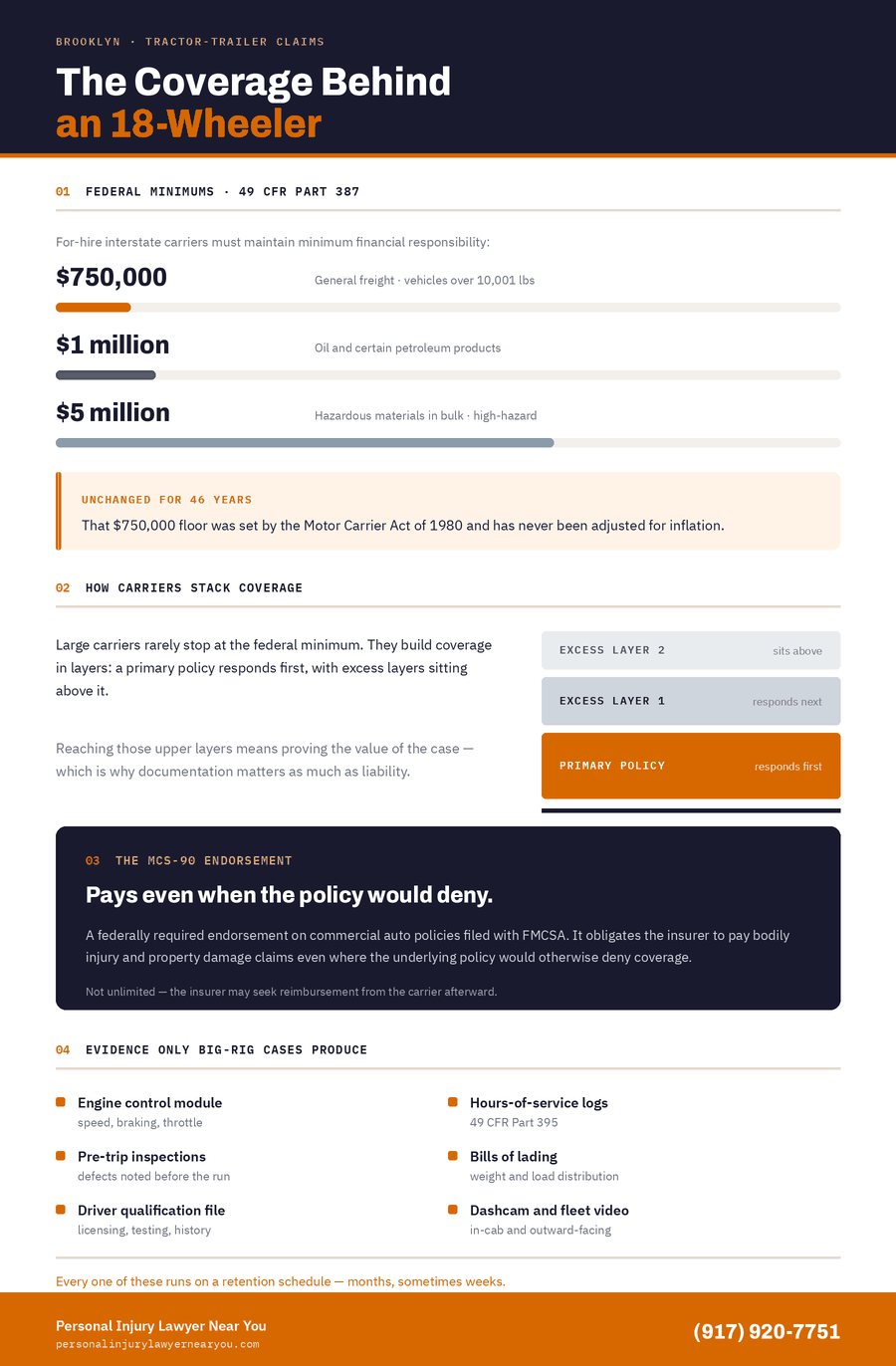
Under 49 CFR Part 387, for-hire interstate carriers must maintain minimum levels of financial responsibility:
- $750,000 — general freight, vehicles over 10,001 lbs
- $1 million — oil and certain petroleum products
- $5 million — hazardous materials in bulk and high-hazard divisions
Two things about that $750,000 figure matter enormously. First, it dwarfs the minimum on a personal auto policy in New York. Second, it was set by the Motor Carrier Act of 1980 and has never been adjusted for inflation — which means the “minimum” is worth a fraction of what Congress intended when serious injuries are involved.
In practice, large carriers rarely stop at the minimum. They build layered coverage: a primary policy responds first, then excess layers sit above it. Reaching those upper layers requires proving the value of the case, which is why documentation matters as much as liability in a serious semi truck claim.
The MCS-90 Endorsement: A Safety Net Most People Never Hear About
This is one of the more useful things to know if you were hit by a tractor-trailer in Brooklyn.
The MCS-90 is a federally mandated endorsement attached to commercial auto liability policies filed with FMCSA. Its function is protective: it obligates the insurer to pay public liability claims for bodily injury and property damage even where the underlying policy would otherwise deny coverage.
That matters because carriers and insurers frequently dispute coverage after a serious crash — the driver was off-route, the trailer was not scheduled, a condition of the policy was breached. Those arguments can leave an injured person with a valid claim and no accessible policy. The MCS-90 exists to prevent exactly that outcome.
It is not unlimited, and the insurer may seek reimbursement from the carrier afterward. But for the injured person, it can be the difference between a recovery and a judgment nobody pays.
Why 18-Wheeler Crashes Injure Differently
Physics does most of the work here, and Brooklyn’s road design does the rest.
A fully loaded tractor-trailer running at highway speed needs substantially more distance to stop than a passenger car — and far more on the wet, patched surfaces common on the Gowanus. That gap produces the crash types specific to large trucks:
- Underride — a car passing beneath the trailer, the most catastrophic pattern of all
- Jackknife — the trailer swinging out of line, usually under hard braking or a shifting load
- Rollover — high centre of gravity meeting an off-ramp taken too fast
- Wide-turn squeeze — a truck swinging left before turning right, trapping vehicles and cyclists
- Blind-spot collisions — the no-zones along the trailer’s right side and directly behind it
Brooklyn adds its own factors. Truck routes funnel heavy vehicles onto specific corridors, and drivers unfamiliar with low-clearance bridges and tight residential turns end up on streets the trailer barely fits through.
The Evidence That Only Exists in Big-Rig Cases
This is the advantage of a tractor-trailer claim over an ordinary crash: the vehicle documents itself.
Under 49 CFR Part 395, a driver must take ten consecutive hours off duty before driving and may not drive after fourteen consecutive hours following that break. Most drivers now record this electronically, and the rules are designed so the original record survives any edit.
Alongside the logs sit the engine control module data, pre-trip inspection reports, bills of lading showing weight and load distribution, driver qualification files, and increasingly dashcam footage. Every one of those is a document a carrier must produce — and every one of them runs on a retention schedule. Our guide to who is liable in a Brooklyn truck accident covers who has to hand each of them over.
Who Pays — and Why It Is Rarely One Company
An 18-wheeler on a Brooklyn street usually represents four or five separate businesses. The tractor may be owner-operated. The trailer may belong to a leasing company. The cargo belongs to a shipper. A broker arranged the load. The carrier’s name on the door may be none of them.
Each of those relationships is governed by a contract, and each can carry separate coverage. This is why a Brooklyn truck accident lawyer starts by pulling the contracting chain rather than by arguing about the collision itself.
The structure differs from local delivery work, where the employment question dominates — that analysis is covered in our guide for anyone hit by a delivery truck in Brooklyn.
What These Claims Are Worth
Value tracks two things: the severity of the injuries and the coverage you can actually reach.
Because federal minimums start at $750,000 and layered towers climb well beyond that, serious 18-wheeler claims routinely resolve far above ordinary motor vehicle cases. Our breakdown of truck accident settlements in New York gives realistic ranges, and the free personal injury settlement calculator lets you work your own numbers before anyone quotes you a figure.
One 2026 change is worth knowing. New York now applies a modified comparative fault rule under CPLR § 1411(b) to motor vehicle claims: a plaintiff found mostly at fault cannot recover non-economic damages. Carriers lean on this, particularly in lane-change and blind-spot cases where they argue you were in the no-zone. Your fault percentage is negotiable — and now carries more weight than it did.
Frequently Asked Questions
How much insurance does an 18-wheeler carry in New York?
Federal law sets a minimum of $750,000 for interstate carriers hauling general freight in vehicles over 10,001 pounds, rising to $1 million for oil and up to $5 million for hazardous materials. Many large carriers carry far more through layered excess policies. The minimum was set in 1980 and has never been adjusted for inflation.
What is an MCS-90 endorsement and why does it matter to me?
It is a federally required endorsement on commercial auto policies that obligates the insurer to pay bodily injury and property damage claims even where the policy itself would deny coverage. For an injured person it can prevent a coverage dispute between the carrier and its insurer from leaving you with nothing to collect against.
Is a semi truck claim different from a regular car accident claim?
Substantially. Federal safety regulations apply alongside New York law, multiple businesses are usually involved, the available coverage is far higher, and the truck generates documentation — logs, engine data, inspection records — that no passenger car produces. It also means the carrier’s defense team mobilises much faster.
The truck driver said the trailer was not his. Does that hurt my claim?
Usually the opposite. Split ownership between tractor, trailer, and cargo often means more insurance policies rather than fewer. Identifying each owner and the contracts between them is standard work in a tractor-trailer case, and it frequently uncovers coverage nobody volunteered.
How long do I have to file an 18-wheeler accident claim in Brooklyn?
Three years from the date of injury for a personal injury lawsuit in New York, two years for wrongful death, and 30 days for your no-fault application. The practical deadline is much shorter, because logging data, engine module data, and camera footage are governed by retention schedules measured in months or weeks.
Key Takeaways
✅ Federal minimum coverage starts at $750,000 — far above any personal auto policy
✅ That figure was set in 1980 and never adjusted for inflation
✅ The MCS-90 endorsement can force payment even when the policy would deny
✅ Split tractor, trailer, and cargo ownership usually means more policies, not fewer
✅ Logs, engine data, and inspection records exist — but only for a limited time
Hit by an 18-Wheeler in Brooklyn?
The carrier’s investigators work fast, and the records that prove what happened are on a clock. A Brooklyn 18 wheeler accident attorney can send preservation letters, pull the contracting chain, and identify every layer of coverage before those windows close. Any Brooklyn personal injury claim against a commercial carrier rises or falls on that early work. The case review is free, and there is no fee unless you win.
Get Connected With a Brooklyn 18 Wheeler Accident Lawyer Today
Free case review. No win, no fee. No upfront cost.
Want more NYC injury guides and legal news from PILNY in your Google results?
