
TL;DR — Quick Summary
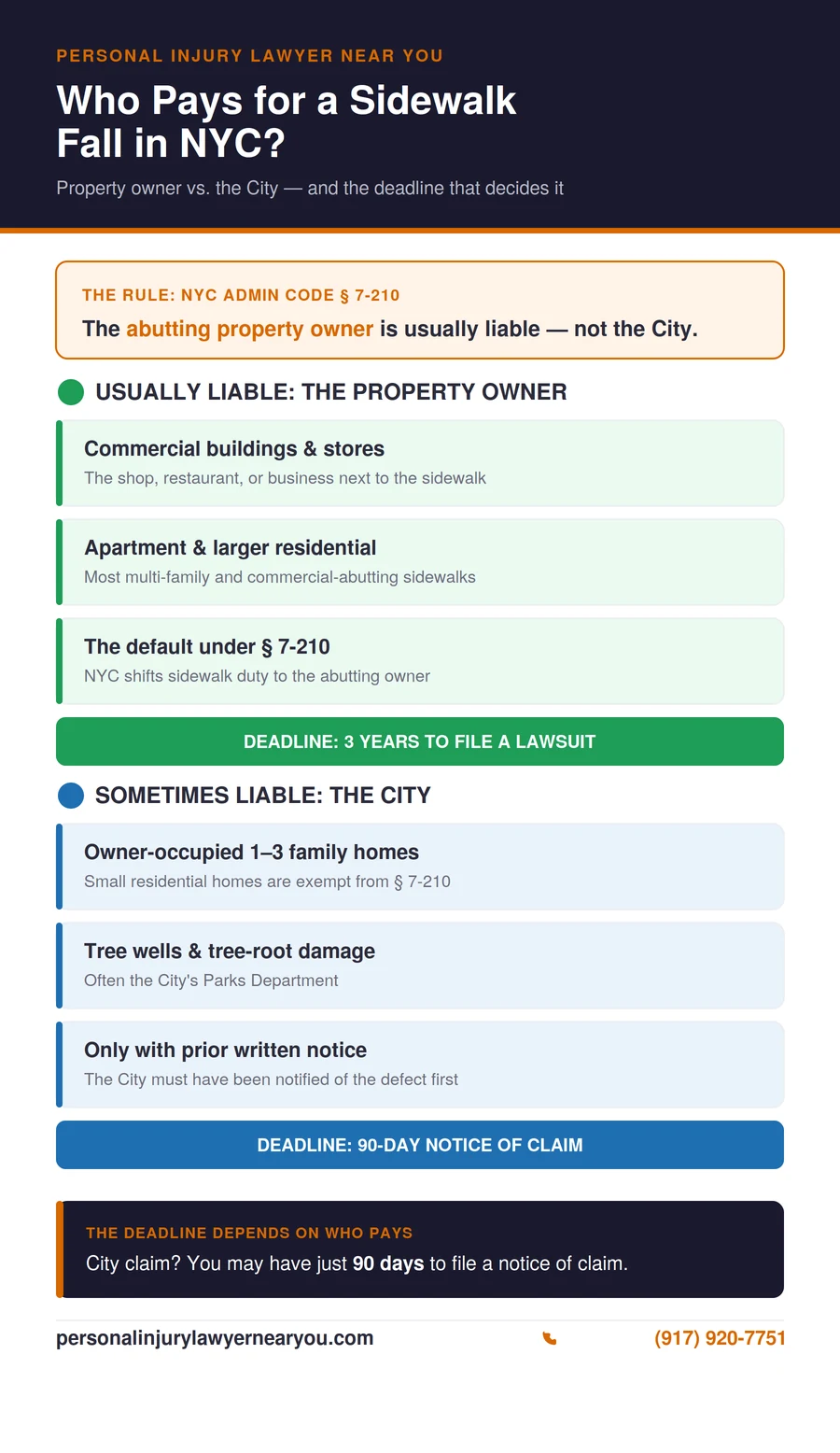
After a sidewalk slip and fall in NYC, the owner of the building next to the sidewalk is usually liable under Administrative Code § 7-210. But outside a one-, two- or three-family home that the owner lives in — the kind that lines whole neighbourhoods in Queens, Brooklyn, the Bronx and Staten Island — the claim usually runs against the City instead, with a 90-day notice of claim and a prior written notice requirement. Curbs and tree wells generally stay with the City too. Check the property type before the 90 days run out.
The answer to who is liable for a sidewalk slip and fall in New York City depends almost entirely on what kind of building you fell in front of. In Manhattan, it is nearly always a commercial or multi-family building owner — our Manhattan sidewalk fall guide covers that situation. In the residential parts of the other four boroughs, the picture changes, because one exception in the law covers a huge number of homes.
The Rule and the Exception
Since 2003, Administrative Code § 7-210 has made the owner of the abutting property responsible for keeping the sidewalk reasonably safe, and liable for injuries when they fail to. The exception: the law does not apply to a one-, two- or three-family residential property that is owner-occupied and used exclusively as a home. For those, the City generally remains responsible for the sidewalk.
| You fell in front of… | Usual defendant | First deadline |
|---|---|---|
| A store, office, apartment building of four or more units | The building owner | Lawsuit within 3 years |
| A 1–3 family house rented out, with no owner living there | The owner — the exception does not apply | Lawsuit within 3 years |
| A 1–3 family house with a shop or office on the ground floor | The owner — not exclusively residential | Lawsuit within 3 years |
| A 1–3 family house the owner lives in | The City of New York | Notice of claim within 90 days |
How to Check Whether the House Is Owner-Occupied
You do not have to guess. Public records usually answer it within a day:
- The deed. The City’s ACRIS records system shows who owns the property and the address on the deed.
- The tax class. Department of Finance records show the building class — one-, two- and three-family homes fall in tax class 1 — and the number of units.
- The owner’s mailing address. If tax bills go to a different address, the owner may not live there.
- Exemptions. A STAR property tax benefit generally requires the home to be the owner’s primary residence, which points toward owner-occupancy.
- What you can see. A shop sign, a home office plate or extra mailboxes are worth photographing — they can defeat the “exclusively residential” condition.
Because the answer decides whether you face a 90-day or a three-year deadline, treat every fall outside a small house as if the 90-day clock is running until you know.
Where the Exception Matters: Borough by Borough
The owner-occupied exception is rare in Manhattan but common elsewhere. Large parts of Staten Island, eastern and southeastern Queens, southern Brooklyn and the northeast Bronx are made up of exactly the one- to three-family homes it covers. A fall on a residential block in Bayside, Marine Park, Throgs Neck or Great Kills is far more likely to be a City claim than a fall in Midtown. If you fell in one of those areas, a Queens slip and fall lawyer or a Staten Island slip and fall lawyer will check the property records first.
Suing the City: Prior Written Notice
When the City is the right defendant, there is a second hurdle. Under the City’s “Pothole Law” (Administrative Code § 7-201), it generally cannot be held liable for a sidewalk defect unless it had prior written notice of that defect — or created it. In practice, notice most often comes from maps filed with the Department of Transportation by the Big Apple Pothole and Sidewalk Protection Corporation, which mark defects block by block. Those maps, DOT complaint records and any earlier repair orders are requested through the City, and they decide many of these cases. Our guide to the NYC notice of claim explains how to serve the notice and what happens at the 50-h hearing that follows.
Curbs, Tree Wells and Snow: The Special Rules
- Curbs. Courts have generally treated the curb as outside the “sidewalk” covered by § 7-210, so a defective curb usually remains the City’s responsibility, even in front of a commercial building.
- Tree wells. In Vucetovic v Epsom Downs (2008), New York’s highest court held that a tree well is not part of the sidewalk under § 7-210. A fall caused by a tree well or its edge usually points back to the City.
- Snow and ice. Owners covered by § 7-210 are responsible for snow and ice on their sidewalk, and the City’s snow-removal rule generally gives them four hours after snow stops falling to clear a path, not counting overnight hours. During a storm and for a reasonable time after, owners are generally not liable — so the weather records for the day matter.
- Cellar doors and grates. Hardware set into the sidewalk usually belongs to the building or a utility; the owner of that specific piece is the defendant.
Is the Defect Big Enough?
There is no fixed height in New York. Defendants often argue a defect was “trivial”, and courts look at its width, depth and edges together with the lighting, foot traffic and whether it was easy to see. Photographs taken the same day, with a coin or ruler for scale and before anyone repairs it, are the most valuable evidence you can gather.
Deadlines
- Against a private owner: generally three years to sue.
- Against the City: a notice of claim within 90 days, then a lawsuit within one year and 90 days of the fall.
- Against NYCHA (a fall outside a public housing development): the same 90-day notice rule.
If you fell on a walkway or stairs inside a building’s grounds rather than the public sidewalk, the rules are different — see our guide to an apartment building slip and fall in NYC.
What to Do After a Sidewalk Fall
- Photograph the defect from several angles with something for scale, plus the whole frontage and the building.
- Note the exact address and which property the sidewalk fronts — and whether it looks like a small house, a shop or an apartment building.
- Get medical care the same day, so the record ties the injury to the fall.
- Get witness details, including anyone who knows how long the defect has been there.
- Do not give a recorded statement to the owner’s insurer before getting advice.
Frequently Asked Questions
Who is liable for a sidewalk slip and fall in NYC?
Usually the owner of the abutting property under Administrative Code § 7-210. The main exception is an owner-occupied one-, two- or three-family home used only as a residence, where the City of New York is generally responsible instead.
How do I know if a house is owner-occupied?
Check the deed in the City’s ACRIS system, the building’s tax class and number of units, whether tax bills go to the same address, and whether the home has a STAR benefit, which generally requires it to be the owner’s primary residence.
Can I sue the City of New York for a sidewalk fall?
Yes, when the sidewalk fronts an owner-occupied one- to three-family home, or the defect is a curb or tree well. You generally must show the City had prior written notice of the defect, and you must serve a notice of claim within 90 days.
Who is responsible for a fall at a tree well in NYC?
Usually the City. In Vucetovic v Epsom Downs (2008), New York’s highest court held that a tree well is not part of the sidewalk for purposes of § 7-210.
How long do property owners have to clear snow from NYC sidewalks?
The City’s rule generally gives owners four hours after snow stops falling to clear a path, not counting overnight hours. Owners are generally not liable for falls during a storm or for a reasonable time afterwards.
How long do I have to file a sidewalk slip and fall claim?
Three years against a private property owner. Against the City or NYCHA, a notice of claim is due within 90 days and the lawsuit within one year and 90 days.
Key Takeaways
✅ The abutting owner is usually liable — except outside owner-occupied 1–3 family homes
✅ That exception is common in Queens, Brooklyn, the Bronx and Staten Island
✅ Check the deed, tax class and STAR status to find out which applies
✅ Curbs and tree wells generally stay with the City
✅ City claims need a notice within 90 days and prior written notice of the defect
Get a Free Case Review
Not sure whether the owner or the City is responsible? A free review can pull the property records and check for prior notice before the 90-day deadline passes. We connect injured pedestrians with a Brooklyn slip and fall lawyer and attorneys across all five boroughs.
Injured on a Broken NYC Sidewalk? Find Out Who Owes You
Free case review. No win, no fee. No upfront cost.
