
TL;DR — Quick Summary
What to do after a truck accident in the Bronx: call 911, get treated the same day, and photograph the truck’s USDOT number, company name and plate. Bronx truck traffic comes in two kinds — interstate tractor-trailers crossing on the Cross Bronx, and local box trucks serving Hunts Point and the borough’s warehouses — and they carry very different insurance. Truck data is not kept automatically: engine and logging records can be lost unless a preservation letter goes out quickly. As a car occupant, your own no-fault pays first, and a pain-and-suffering claim must meet the 2026 rules.
Knowing what to do after a truck accident in the Bronx starts with knowing which kind of truck hit you. The Bronx carries some of the heaviest freight traffic in the country: long-haul rigs between the George Washington Bridge and New England on the Cross Bronx, and a constant flow of local trucks in and out of the Hunts Point food distribution center and the industrial strips along the Bruckner and Major Deegan.
At the Scene
- Call 911 and ask for police and EMS. Get the report number and precinct.
- Photograph the truck’s door — the company name and the USDOT number. That number identifies the carrier and its federal safety record.
- Photograph the trailer separately — trailer number, owner markings and any cargo labels. The trailer is often owned by someone other than the tractor’s carrier.
- Photograph positions before anything moves: lanes, the truck’s turn path, mirrors and blind-spot angles.
- Get the driver’s details — name, licence, employer and insurer — and say nothing about fault.
- Note cameras at warehouses, gas stations and businesses along the route. Commercial sites often have good coverage, but it is recorded over.
Get treated the same day. The Bronx’s Level 1 trauma centers include Jacobi Medical Center and Lincoln Medical Center. Truck crashes cause injuries that often look minor at the scene and are not.
Two Kinds of Bronx Truck, Two Kinds of Insurance
| Interstate tractor-trailer | Local box truck or van | |
|---|---|---|
| Where | Cross Bronx, Bruckner, Deegan, bridge approaches | Hunts Point, Port Morris, local streets and shopping strips |
| Federal rules | Hours-of-service, electronic logs, inspection and drug-testing rules apply | Many federal rules apply only above weight thresholds or to interstate trips |
| Insurance | For-hire interstate carriers generally must carry at least $750,000 | Often only the business’s commercial auto policy, which may be far lower |
| Who else may be liable | Carrier, trailer owner, broker, shipper or loader | Employer, vehicle owner, the business that hired the delivery |
The $750,000 figure is a federal minimum for for-hire interstate carriers over 10,001 pounds — it does not cover every truck. Our guide to box truck versus tractor-trailer insurance explains how to tell which regime applies. You can look up any carrier by its USDOT number on the FMCSA SAFER company snapshot.
The Records That Have to Be Preserved
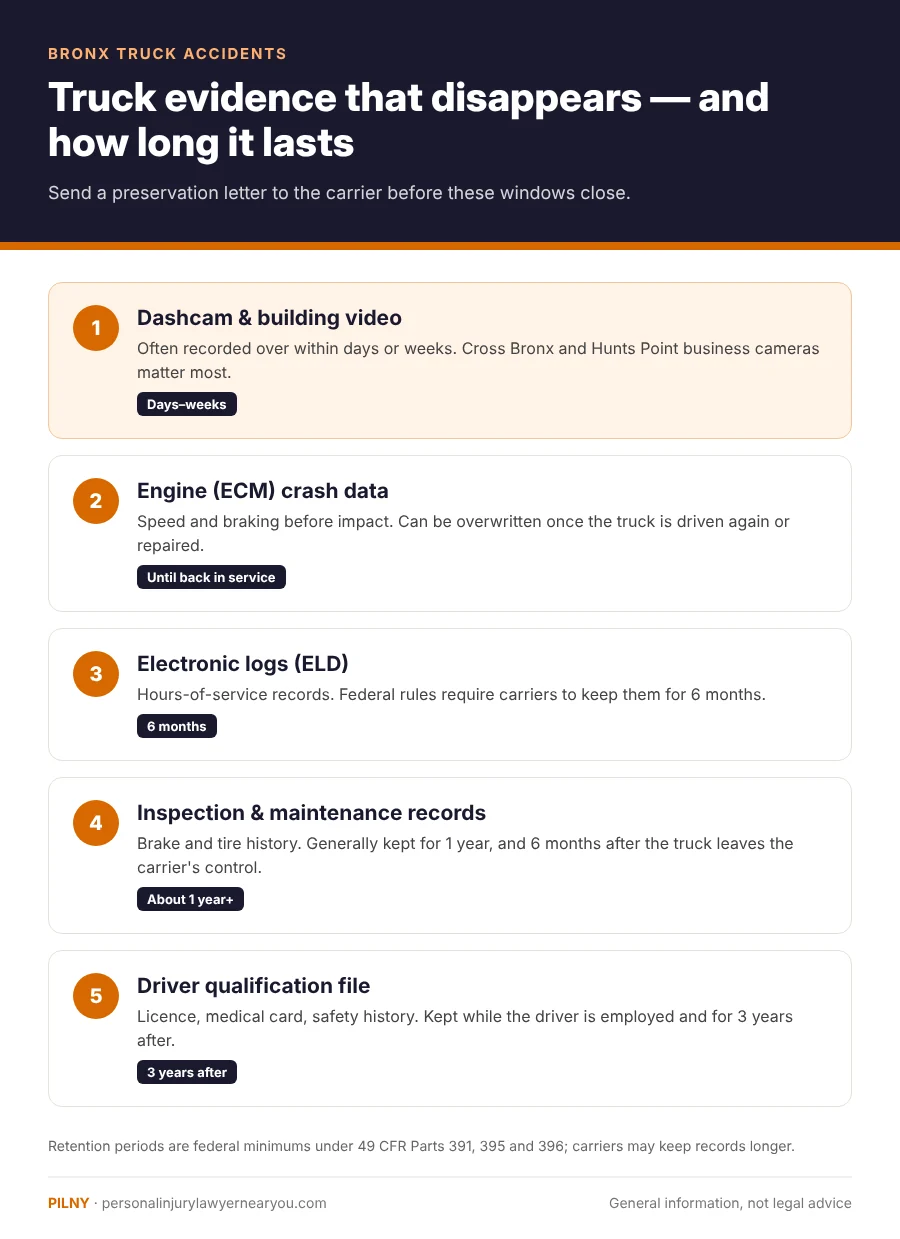
A truck’s “black box” is not one device with a fixed retention period. Most of the data sits in the engine’s control module and the electronic logging device, and nothing obliges the carrier to keep crash data unless it is asked to. The key records:
- Engine control module data — speed, braking and throttle before the crash. It can be overwritten as the truck keeps running.
- Electronic logging device records — hours of service. Federal rules require carriers to keep them for six months under 49 CFR Part 395.
- Post-crash drug and alcohol tests — required in qualifying crashes within strict time limits.
- Dashcam and telematics footage — many fleets record continuously and overwrite.
- Maintenance and inspection files, especially brakes and tyres.
A preservation (spoliation) letter puts the carrier on notice to keep all of this. Our guide to truck black box data explains what each source records and how fast it goes.
Truck cases rarely have one defendant. The driver, the carrier that employs them, the owner of the trailer, the company that loaded the cargo, a freight broker, and a maintenance contractor can all share responsibility, each with its own insurance. Our guide to Cross Bronx Expressway truck accidents looks at the crash patterns on the borough’s busiest truck route.
How Your Claim Is Paid
- Your own no-fault first. If you were in a car, your no-fault insurer pays bills and most lost wages up to the policy limit. File within 30 days.
- Then the truck’s liability coverage for losses above no-fault and for pain and suffering.
- The 2026 rules apply. To claim pain and suffering you must meet the serious injury threshold, which since 2026 needs an objective or permanent injury — something truck crash injuries often do. And since 26 May 2026, a claimant whose fault is greater than the defendants’ combined share cannot recover pain-and-suffering damages.
If a City or State road defect played a part — the Cross Bronx, Bruckner and Deegan are State highways — a separate 90-day notice deadline applies. The claim against the carrier generally has three years.
Where a Bronx Truck Case Is Heard
A Bronx case is filed in Bronx County Supreme Court on the Grand Concourse, with appeals to the Appellate Division, First Department. Interstate carriers sometimes try to move cases to federal court; whether they can depends on where the parties are based.
Frequently Asked Questions
What should I do right after a truck accident in the Bronx?
Call 911, photograph the truck’s USDOT number, company name, plate and trailer number, photograph vehicle positions, get the driver’s details without discussing fault, and get medical care the same day.
How much insurance does a truck carry?
For-hire interstate carriers over 10,001 pounds generally must carry at least $750,000 under federal rules. Local delivery trucks often carry only a business auto policy, which may be much lower.
How long is truck black box data kept?
There is no fixed rule for engine data, which can be overwritten as the truck keeps running. Electronic logging records must be kept for six months. A preservation letter should go out as soon as possible.
Who can be liable in a Bronx truck accident?
The driver, the carrier, the trailer owner, the shipper or loader, a freight broker, and a maintenance contractor can all share liability, depending on what caused the crash.
Does no-fault cover me if a truck hit my car?
Yes. Your own no-fault coverage pays your medical bills and most lost wages first, whoever caused the crash. Losses above that, and pain and suffering, are claimed from the truck’s insurance.
How long do I have to sue after a Bronx truck accident?
Generally three years against the carrier and driver. A claim against the City or State for a road defect needs notice within 90 days.
Key Takeaways
✅ Photograph the USDOT number, company name, plate and trailer number
✅ Interstate rigs and local box trucks carry very different insurance
✅ Truck data is not kept automatically — a preservation letter matters
✅ Your own no-fault pays first; the truck’s coverage pays the rest
✅ Bronx cases are heard in Bronx County and appealed to the First Department
Talk to Someone About Your Bronx Truck Crash
A free case review can identify every liable party, the insurance behind each, and the evidence to preserve first. Learn how we connect injured people with a Bronx truck accident lawyer.
Hit by a Truck in the Bronx? Get a Free Case Review
No win, no fee. No upfront cost.
Want more NYC injury guides and legal news from PILNY in your Google results?
