
TL;DR — Quick Summary
Who’s liable in a Queens truck accident? Almost never just the driver. Depending on the cause, responsibility can be shared by the trucking company, the cargo loader, a maintenance contractor, a parts manufacturer, and even the city — each with its own insurance policy. On trucking subreddits, drivers routinely tell crash victims to “just document it and move on,” or that “no police report means it doesn’t matter.” Under New York law, that advice can quietly cost you your case. Here’s who can actually be held responsible, what real trucker discussions reveal, and the deadlines that decide whether you recover anything at all.
Who is liable in a Queens truck accident is the question that decides how much your claim is worth — and the answer is usually “more parties than you think.” Unlike an ordinary two-car crash, a commercial truck collision can pull in a web of defendants, each carrying separate insurance. Identifying all of them is exactly why truck cases settle for far more than car cases: more liable parties means more available coverage, which means a larger potential recovery. A Queens truck accident lawyer maps out every one of those parties before the trucking company’s insurer can steer you toward a quick, low settlement.
To see how this plays out in the real world, it helps to look at how truckers themselves talk about crashes. Spend time on r/Truckers and you’ll notice something: the drivers on the road every day understand the physics and the risks intuitively — but when it comes to who is legally on the hook, the advice gets shaky fast. That gap is where victims lose money, and it is why knowing what to do after a truck accident in New York matters from the very first day.
What Reddit Gets Right — and Dangerously Wrong — About Truck Liability
Real trucker threads are a goldmine for understanding how crashes actually happen. But they’re a minefield for legal advice. Four recurring themes on r/Truckers show exactly where the community instinct is useful — and where it can sink a claim.
“The other guy took off — just move on”
In one widely-read thread, a driver described being hit by a car that fled the scene, then asked whether to worry about it. The top replies were casual: if your boss isn’t concerned, don’t be; the other driver was probably uninsured and running from the cops; pull the dashcam for your own records and move on. One commenter summed up the group mood bluntly — no police report, so it “doesn’t really matter.”
What’s right: the instinct to preserve dashcam footage is exactly correct — that video can be the difference-maker. What’s dangerously wrong: “no police report, doesn’t matter.” In New York, that police report (an MV-104A) is often the official backbone of a claim, and a hit-and-run doesn’t erase your right to compensation — it can actually open up uninsured-motorist coverage. Treating a fled-scene crash as a shrug is how injured people walk away from money they were owed.
“Can I sue the city over this damage?”
Another thread featured a driver fighting a property-damage bill from a city, months after the fact, insisting he wasn’t even moving when the alleged damage happened. The crowd’s response was sharper here: the burden of proof is on whoever is making the claim; they need itemized proof of the actual damage; a bill arriving five or six months later is a red flag; and “get a lawyer” came up more than once.
What’s right: the community nailed two real legal principles — the party claiming damages carries the burden of proof, and documentation is everything. What’s useful for crash victims: this cuts both ways. When a city vehicle causes your crash in Queens — a sanitation truck, a DOT vehicle — the city becomes a potential defendant, but claims against a municipality trigger a brutally short 90-day Notice of Claim deadline that most people never hear about until it’s too late.
“Does an FMCSA complaint even do anything?”
A driver frustrated by a reckless local dump-truck company asked whether reporting them to the FMCSA would accomplish anything. The thread turned into a genuinely useful debate: some explained that the FMCSA can revoke a carrier’s operating authority and issue Notices of Violation through its Compliance, Safety, and Accountability (CSA) program; others pointed out the tangle of interstate versus intrastate authority and DOT numbers; and several agreed that video plus the truck’s DOT number is the way to surface a carrier’s safety and insurance record.
What’s right: FMCSA violations are real leverage. What victims should take from it: when a trucking company breaks federal safety rules — hours-of-service limits, maintenance requirements, logging rules — those violations become some of the strongest evidence in an injury claim. A carrier’s FMCSA record can turn a “he-said-she-said” crash into a documented liability case.
“A trucker’s worst nightmare”
In a thread asking drivers to name their worst fear, the answers were visceral: a steer-tire blowout on a narrow road, a loaded dump truck’s tire exploding, and — repeatedly — “losing brakes.” These aren’t hypotheticals to the people who drive these rigs; they’re the mechanical failures they dread most.
Why it matters legally: every one of those nightmares points at a liable party beyond the driver. A brake failure points to the maintenance contractor. A tire blowout from a defect points to the manufacturer. When the thing that caused your crash is mechanical, the driver may not be the one who’s truly responsible.
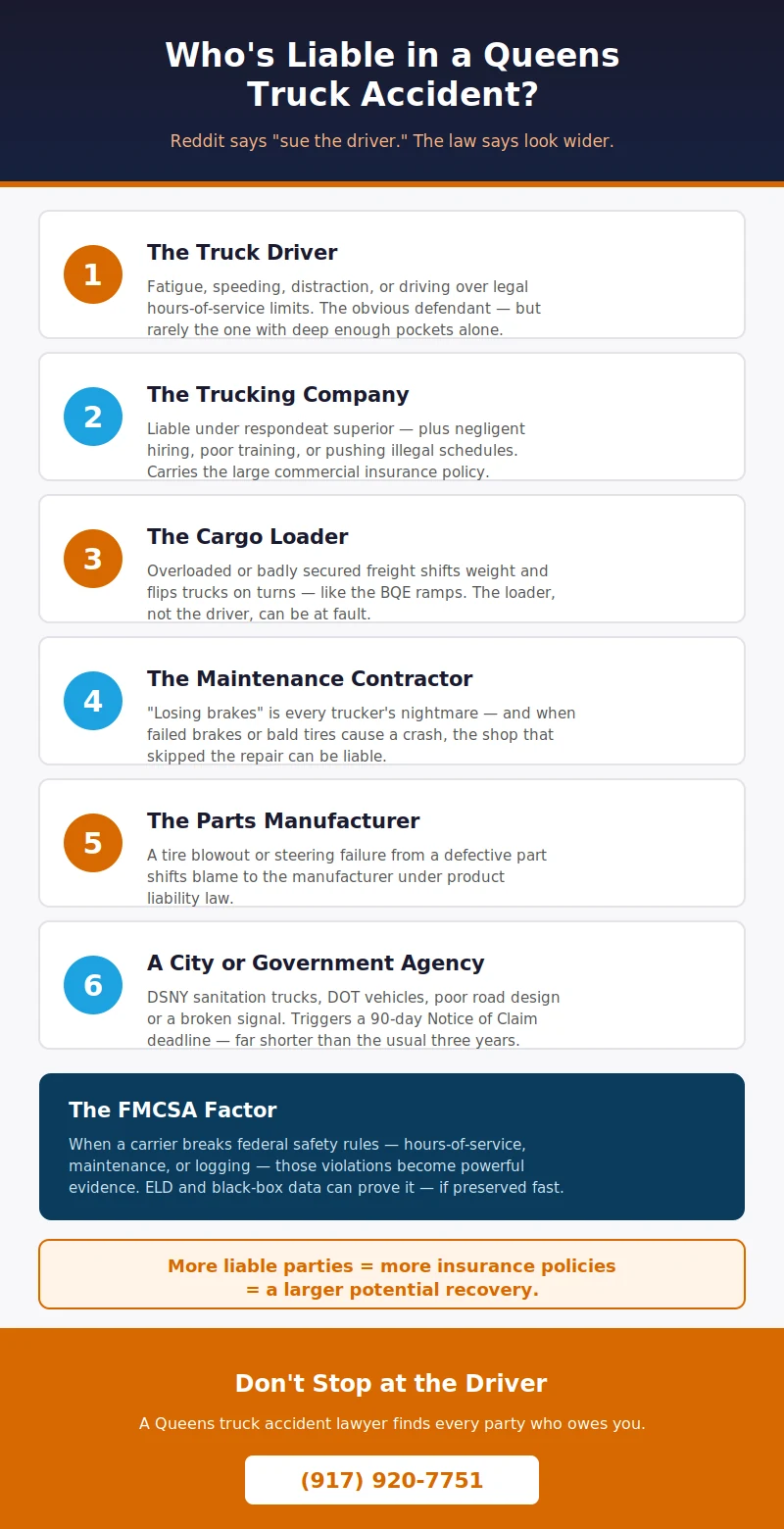
The Six Parties Who Can Be Liable in a Queens Truck Accident
Putting the community instinct together with New York law, here are the parties a thorough investigation looks at:
1. The Truck Driver
Speeding, distraction, fatigue, impairment (CDL holders face a 0.04% BAC limit — half the normal limit), or driving past federal hours-of-service caps. The most obvious defendant, but often not the one with enough insurance to cover a serious injury alone.
2. The Trucking Company
Under respondeat superior, an employer is responsible for an employee’s negligence on the job. Companies can also be directly liable for negligent hiring, inadequate training, or pressuring drivers to run illegal hours. This is where the large commercial insurance policy usually sits. Note: carriers often argue a driver was an “independent contractor” to dodge liability — but courts look past the label at who actually controlled the schedule, route, and equipment.
3. The Cargo Loader
If freight is overloaded or improperly secured, it can shift in transit and make a truck impossible to control — tipping it on a sharp turn like a Brooklyn-Queens Expressway ramp. When that happens, the third-party company that loaded the freight can be at fault even if the driver did nothing wrong.
4. The Maintenance Contractor
The “losing brakes” nightmare in real life. When failed brakes, bald tires, or a neglected repair cause a crash, the shop responsible for maintaining the truck can share liability. Maintenance logs, service invoices, and inspection reports are the evidence that proves it.
5. The Parts Manufacturer
A truck has thousands of parts. If a tire blows out, a brake component fails, or a steering part breaks because it was defective, the manufacturer can be liable under product liability law — especially when a relatively new part fails unexpectedly.
6. A City or Government Agency
A DSNY sanitation truck, an MTA or DOT vehicle, a poorly designed intersection, or a broken traffic signal can put a government entity on the hook. But suing a municipality in New York means filing a Notice of Claim within 90 days — one of the most common ways Queens victims lose an otherwise strong case.
How FMCSA Violations Prove Liability
The Federal Motor Carrier Safety Administration sets the rules commercial trucks must follow, and breaking them is powerful evidence of negligence:
- Hours-of-service (49 CFR Part 395): drivers are capped at 11 hours of driving after 10 hours off duty, inside a 14-hour window, with weekly limits. Fatigued driving from HOS violations is a leading cause of serious truck crashes.
- Electronic Logging Devices (ELDs): these record the driver’s hours and can prove a violation — but the data isn’t kept forever.
- Maintenance and inspection rules: FMCSA requires documented repairs; skipped maintenance that causes a crash is strong evidence against the carrier.
This is why moving quickly matters so much. The ELD data, black-box records, and driver logs that prove an FMCSA violation can be overwritten or discarded within months. Knowing what to do after a truck accident in New York — especially sending a preservation letter early — is often what keeps that evidence alive. For the seventh party in the chain — the shipper or freight broker — and how leased trucks add another policy, see who is liable in a Brooklyn truck accident.
What If You Were Partly at Fault?
You can still recover. New York uses comparative fault: if you were partly responsible, your compensation is reduced by your percentage of fault rather than eliminated. One exception was added in 2026: in motor vehicle lawsuits started on or after May 26, 2026, a claimant whose fault is greater than the defendants’ combined fault cannot recover non-economic damages such as pain and suffering. In multi-party truck crashes, fault is often spread across several defendants — which is another reason having someone map out every liable party works in your favor. For a realistic sense of what your claim might be worth, our free personal injury settlement calculator is a good starting point.
Frequently Asked Questions
Who is liable in a Queens truck accident?
Liability can extend well beyond the driver. Depending on the cause, the trucking company, the cargo loader, a maintenance contractor, a parts manufacturer, and even a city agency may share responsibility — each with separate insurance. Identifying every liable party is what maximizes your potential recovery.
Can the trucking company be liable if the driver was an “independent contractor”?
Often, yes. Trucking companies frequently use the independent-contractor label to distance themselves from liability, but courts look past the label at the actual relationship — whether the company controlled the driver’s schedule, route, and equipment. Many so-called independent contractors are, in substance, employees for liability purposes.
How do FMCSA violations affect my truck accident claim?
They can be decisive. When a carrier violates federal rules — hours-of-service limits, maintenance requirements, or logging rules — those violations are strong evidence of negligence. ELD data, black-box records, and driver logs can prove them, but that evidence can disappear within months, so acting quickly to preserve it is critical.
Is Reddit a reliable place to figure out who’s liable after a truck crash?
Use it for perspective, not for legal conclusions. Trucker communities understand how crashes happen better than anyone, but liability advice on Reddit is often oversimplified or based on other states’ laws. Common takes like “no police report, so it doesn’t matter” are simply wrong in New York and can cost victims their claims.
What if a city-owned truck caused my crash in Queens?
A city agency can be held liable, but claims against a municipality in New York require filing a Notice of Claim within just 90 days of the crash — far shorter than the three-year deadline for suing a private company. Missing it can end an otherwise strong case, so identifying government involvement early is essential.
Key Takeaways
✅ Six parties can share liability: driver, trucking company, cargo loader, maintenance contractor, parts manufacturer, and the city
✅ More liable parties means more insurance policies — and a larger potential recovery
✅ Reddit gets the physics right but the law wrong — “no police report, doesn’t matter” is false in New York
✅ FMCSA violations (hours-of-service, maintenance, logging) are powerful liability evidence — if preserved fast
✅ A city-owned truck triggers a 90-day Notice of Claim deadline, far shorter than the usual three years
Injured in a Queens Truck Crash? Find Out Who’s Really Liable
The trucking company’s insurer wants you to believe the driver is the only party — and to settle before you learn otherwise. A Queens truck accident attorney investigates every layer of liability, preserves the FMCSA and black-box evidence, and pursues every available policy. The case review is free, and there’s no fee unless you win.
Get Connected With a Queens Truck Accident Attorney Today
Free case review. No win, no fee. No upfront cost.
Want more NYC injury guides and legal news from PILNY in your Google results?
