
TL;DR — Quick Summary
Mediation is a meeting where a neutral mediator helps you and the defense reach a settlement. It usually happens after depositions, lasts half a day to a day, and is not binding unless both sides sign an agreement. The mediator moves between separate rooms carrying offers and counteroffers. Many personal injury cases settle at mediation or shortly after. In New York City, courts such as Kings County Supreme Court refer most contested civil cases to mediation before trial.
How personal injury mediation works is something most injured people only learn the week before it happens. Your lawyer calls to say a mediation date is set, and suddenly you are wondering whether it’s a hearing, whether you have to speak, and whether you can be forced to accept a number.
The short version: mediation is a structured negotiation, not a trial. No judge decides anything, and nothing is final unless you agree. Below we walk through the process step by step, what to bring, how offers move, and how to prepare so you walk out with the best realistic result.
What Is Personal Injury Mediation?
Mediation is a form of alternative dispute resolution. A trained, neutral mediator, often a retired judge or an experienced injury lawyer, meets with both sides to help them find a settlement. The mediator doesn’t take sides and can’t impose a result. Their job is to test each side’s arguments, deliver offers and keep talks moving.
| Mediation | Arbitration | Trial | |
|---|---|---|---|
| Who decides? | You and the defense, together | An arbitrator | A judge or jury |
| Binding? | Only if you sign an agreement | Usually yes | Yes, subject to appeal |
| Evidence rules | Informal | Relaxed | Strict |
| Time | Half a day to a day | A day or two | Days to weeks |
| Private? | Yes, confidential | Mostly | Public record |
When Does Mediation Happen in a Personal Injury Case?
Mediation can happen before a lawsuit is filed, but in most injury cases it comes after the lawsuit, once discovery and depositions are mostly done. By then both sides know the medical records, the testimony and the weaknesses in their own case, which makes realistic offers possible.
Courts encourage it too. The Kings County Supreme Court ADR program in Brooklyn treats most contested civil cases as presumptively eligible for mediation before trial, and courts can refer parties at any point after a case starts. A mediation date often follows a key deposition, as covered in our guide to how many personal injury cases go to trial.
How Personal Injury Mediation Works: Step by Step
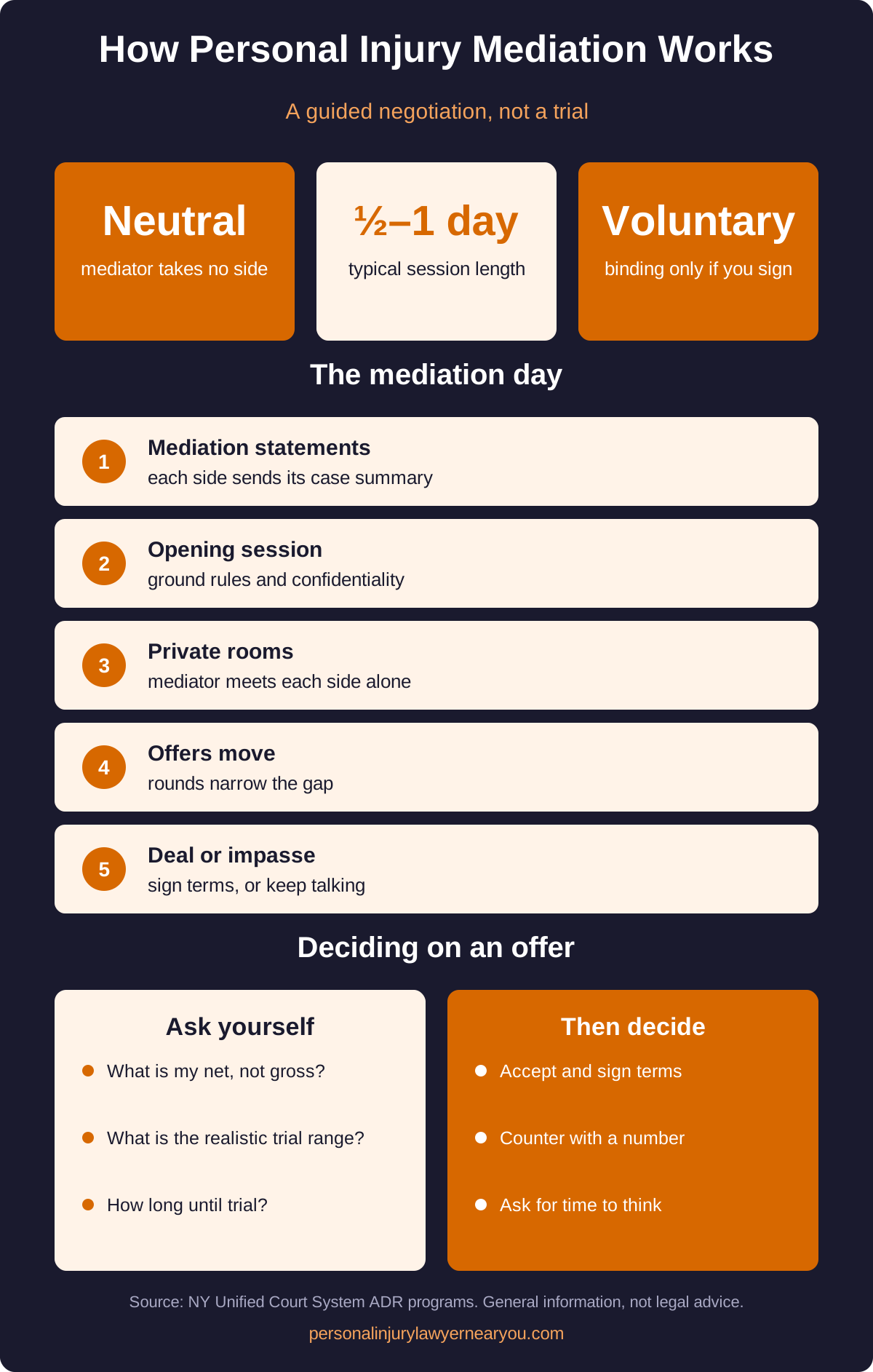
1. Mediation statements
A week or two before, each lawyer sends the mediator a confidential summary of the case: the facts, the injuries, the medical costs, the legal issues and their view of the value. Your lawyer may also send photos, medical summaries or a short video.
2. The opening session
Everyone may meet together briefly. The mediator explains the ground rules, especially confidentiality, and each lawyer may give a short opening. Some mediators now skip the joint session and go straight to separate rooms to keep things calm.
3. Private sessions (caucuses)
This is where most of the day is spent. You and your lawyer sit in one room, the defense lawyer and insurance adjuster in another. The mediator moves between rooms, discusses strengths and weaknesses privately with each side and carries offers back and forth.
4. Offers and counteroffers
Early numbers are usually far apart. The defense may open low and your side high. Over several rounds the gap narrows. Mediators sometimes suggest a bracket (“we’ll move to X if you move to Y”) or, late in the day, a mediator’s proposal, a single number both sides accept or reject privately.
5. Agreement or impasse
If both sides agree, the key terms are written and signed before anyone leaves, and the formal release and payment follow. If not, the case returns to the litigation track, but talks often continue, and many cases settle within weeks of an unsuccessful mediation.
What Decides the Number at Mediation?
The insurer’s offer is driven by how it expects a jury to see the case. The main factors are:
- Liability. How clear fault is, and whether you share any of it.
- Injuries and treatment. Objective injuries, surgery and consistent treatment raise value.
- Your consistency. How credible you were at your deposition, and whether it matches what you told doctors and adjusters early on, which is why our post on what not to say to an insurance adjuster matters long before mediation.
- Insurance limits. A policy limit can cap what is realistic, whatever the case is worth.
- Venue. Juries in different boroughs value cases differently, and insurers know it.
For a sense of how adjusters calculate value before the mediation even starts, see our guide to average personal injury settlement amounts in New York.
Mediation in Different Types of Injury Cases
The format is the same, but the arguments change with the case. In car crashes, the debate is often whether the injury meets New York’s serious injury threshold and how much of the other driver’s policy is available. In falls, it is usually about notice: whether the owner knew or should have known about the hazard, as explained in our guide to sidewalk slip and fall liability in NYC. In truck cases there may be several insurers in the room, each trying to push the cost onto the others, which can make a mediator especially useful.
What to Bring and How to Act on Mediation Day
- Bring any updated medical bills or records your lawyer doesn’t have.
- Bring a list of out-of-pocket costs, lost time from work and how the injury affects daily life.
- Dress as you would for an important meeting.
- Plan for a long day; bring medication, snacks and a phone charger.
- Stay calm, even if early offers are insulting. Low openers are normal.
- Don’t discuss the case with the other side directly. Let the mediator and your lawyer carry messages.
What Happens After a Successful Mediation?
A handshake at mediation is the start of the paperwork, not the end. The usual sequence is:
- Signed term sheet. The amount, who pays, and any special conditions are written down before you leave.
- General release. You sign a release ending your claims against the settling defendants. Read it carefully, and ask your lawyer to explain anything unclear.
- Lien resolution. Your lawyer confirms final amounts with medical lienholders, Medicaid or Medicare, and any workers’ compensation carrier.
- Payment. In New York, CPLR 5003-a generally requires a settling defendant to pay within 21 days after receiving the signed release and related papers, with some exceptions for government defendants.
- Closing statement. You receive a written breakdown of the gross settlement, the fee, expenses, liens and your net amount.
Can You Go to Mediation Without a Lawyer?
You can, and some smaller claims are mediated through community programs without lawyers. But in a lawsuit, the defense will almost always have a lawyer and an insurance adjuster in the room. Without your own lawyer, it is hard to judge whether an offer is fair, how liens will be handled or what the release really covers. Our guide to handling a personal injury claim without a lawyer explains where doing it yourself works and where it usually doesn’t.
Costs: Who Pays the Mediator?
Private mediators charge by the session or the hour, and the fee is usually split between the parties. Your share is normally advanced by your lawyer and repaid from the settlement as a case expense, the same way as other costs described in our breakdown of personal injury lawyer fees in New York. Some court and community programs offer free or low-cost mediation.
How Personal Injury Mediation Works for You: How to Decide Whether to Accept
The hardest moment at mediation is when a real offer is on the table and you have to decide. These questions help.
What is the net, not the gross?
Ask your lawyer to work out what you would actually receive after the fee, expenses and medical liens. A gross offer can sound large and still leave less than you expect once liens are paid.
What is the realistic range at trial?
Your lawyer should explain the likely best case, worst case and most likely result if the case went to a jury, including the chance of losing on liability. Mediation offers are compared against that range, discounted for time and risk.
How long would trial take?
In busy New York City courts, a trial date can be a year or more away. Money now has real value, especially if bills are piling up.
What does the offer leave out?
Check whether the settlement covers all defendants and all claims, how liens will be handled, and when the money will be paid. These details belong in the signed term sheet.
How strong is your evidence today?
Think about what could change before trial. A treating doctor who retires, a witness who moves away or a gap in treatment can weaken a case over time. A case is rarely stronger than it is at a well-prepared mediation.
Are you deciding under pressure?
You can ask for time to think, or ask the mediator for a final number to consider overnight. A decision you can live with matters more than finishing by 5 p.m. Many mediators will keep an offer open for a day or two if both sides agree.
It also helps to decide your walk-away number with your lawyer before the day starts, then adjust only if something new comes up. Setting it in advance keeps you from reacting to the mood in the room instead of the facts of your case.
Understanding how personal injury mediation works takes some of the pressure off. The decision is always yours, and a well-prepared plaintiff with clear numbers makes the strongest choices.
Frequently Asked Questions
How does personal injury mediation work?
Both sides meet with a neutral mediator, usually after key evidence has been exchanged. Each side explains its position, then the mediator moves between separate rooms carrying offers and counteroffers. If they agree, the terms are written down and signed; if not, the case continues toward trial.
Is mediation binding in a personal injury case?
The mediation itself is not binding. Nobody can force you to accept an offer. But if both sides reach an agreement and sign a settlement, that agreement is binding and usually ends the case once the release is signed.
How long does personal injury mediation take?
Most personal injury mediations take half a day to a full day. Complex cases with several defendants or serious injuries can take longer or need more than one session.
What percentage of personal injury cases settle at mediation?
There is no single official figure, but mediation is widely used because a large share of cases settle there or soon after. Even when a deal isn’t reached on the day, the offers made often lead to a settlement in the following weeks.
Do I have to attend personal injury mediation?
Usually yes. Mediators and many courts expect the injured person to attend in person or by video, because you are the one who decides whether to accept an offer. Your lawyer will prepare you and do most of the talking.
Who pays for mediation in a personal injury case?
Private mediators charge a fee, often split between the parties, and the plaintiff’s share is usually advanced by the law firm and repaid from the settlement. Some court programs and community mediation centers offer free or low-cost mediation.
Key Takeaways
✅ Mediation is a negotiation led by a neutral mediator, not a trial
✅ It usually happens after depositions and lasts half a day to a day
✅ Nothing is binding unless both sides sign a settlement
✅ Offers move between private rooms until they meet or talks stop
✅ Judge an offer by your net recovery and the realistic trial range
Preparing for Mediation?
If your case is heading to mediation without a lawyer, or you are unsure whether an offer is fair, a free case review can help you understand what your case is realistically worth.
Mediation Coming Up? Know What Your Case Is Worth
Free case review. No win, no fee. No upfront cost.
Want more NYC injury guides and legal news from PILNY in your Google results?
