
TL;DR — Quick Summary
You probably don’t need a personal injury lawyer for a minor injury that heals in a few weeks, where fault is clear and the insurer is paying fairly. You probably do need one if you needed ongoing treatment, missed real work, fault is disputed, the insurer is pushing a fast settlement, or a government body or commercial vehicle is involved. Because most lawyers work on contingency, the real question is not the fee — it is whether they can recover enough more than you would alone to cover it.
Do I need a personal injury lawyer? It is the first question almost everyone asks after an accident, and the honest answer is: not always. Plenty of small claims are settled fairly without one. But the cases where people go it alone and regret it tend to share the same warning signs — and you can usually spot them in the first few weeks.
This guide is about how to tell which kind of case you have. If your question is specifically about a car crash, our honest answer to should I get a lawyer for a car accident goes deeper on that.
When You Probably Don’t Need a Personal Injury Lawyer
Handling a claim yourself is reasonable when all of these are true:
- The injury was minor — a few doctor visits, no surgery, back to normal within weeks.
- Fault is obvious and accepted — for example, you were rear-ended at a red light and the other insurer has admitted liability.
- You missed little or no work.
- The offer covers your bills and a fair amount for the inconvenience, and nothing new has come up since.
In that situation a lawyer’s percentage may eat most of any extra they could win. Get your medical records, keep every receipt, and do not sign a release until you are confident you have finished treatment.
When Hiring a Personal Injury Attorney Is Worth It
The picture changes fast once any of these appear:
- Serious or lasting injuries — fractures, surgery, head or spine injuries, or treatment still going on months later.
- Disputed fault — the other side blames you, or several parties may share responsibility.
- Pressure from the insurer — requests for a recorded statement, a broad medical authorisation, or a quick cheque in exchange for a release.
- A government defendant — a city bus, a public sidewalk, a state road. These often come with notice deadlines measured in months, not years.
- A commercial defendant — trucking companies, delivery fleets and large property owners have their own lawyers from day one.
- Lost earning ability — you cannot go back to the same job, or you are self-employed and lost contracts.
- The deadline is approaching and the insurer is still “reviewing” your file.
An adjuster is a trained negotiator whose job is to close files cheaply. Our list of things never to say to an insurance adjuster shows how ordinary phrases get used to cut a claim.
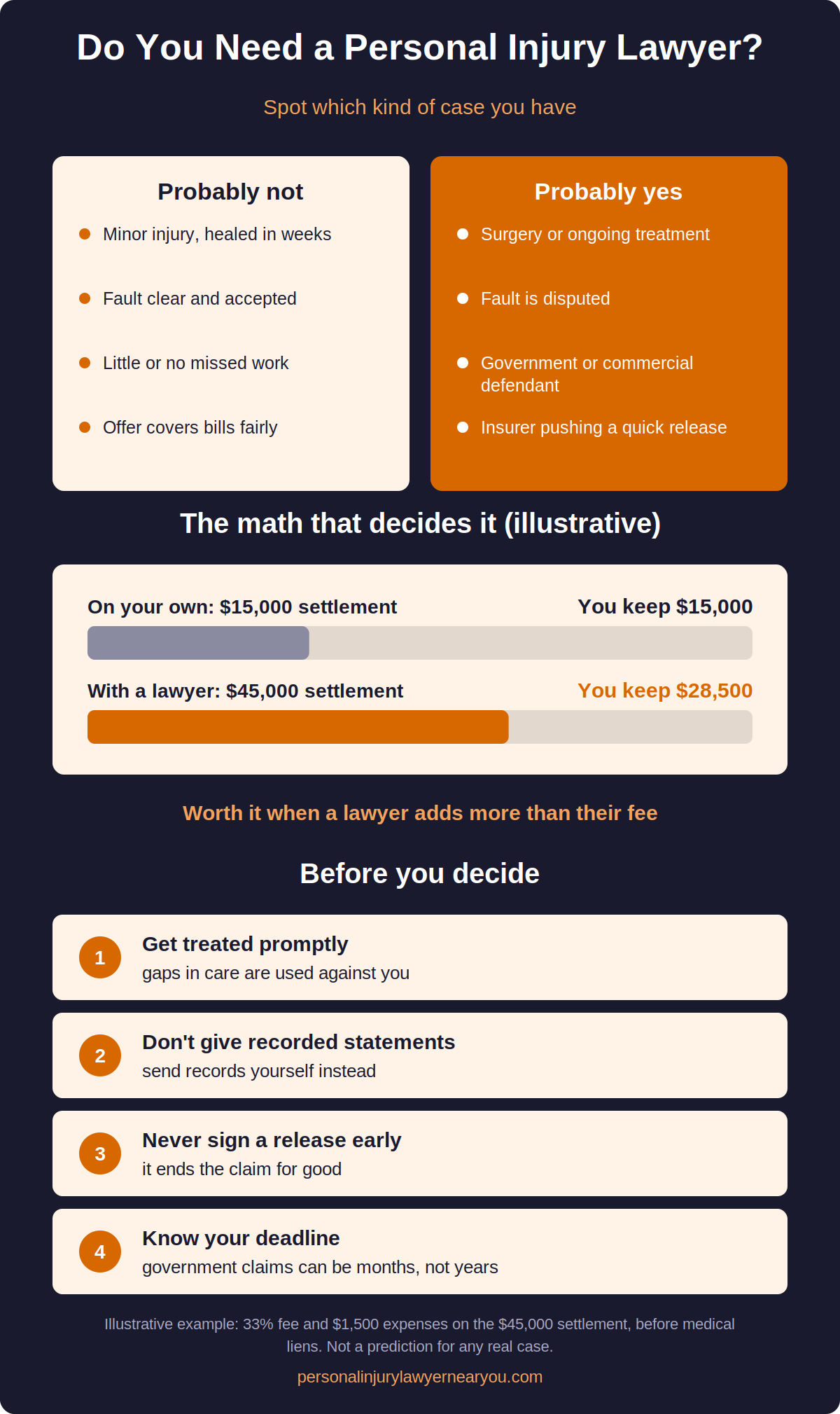
Is It Worth Hiring a Personal Injury Lawyer? The Math
People often decide on the fee alone: “Why give away a third?” The better question is what you keep at the end. Here is a simple illustration with made-up numbers — not a prediction for any real case.
| Hypothetical example | On your own | With a lawyer |
|---|---|---|
| Settlement | $15,000 | $45,000 |
| Lawyer’s fee (33%) | $0 | −$15,000 |
| Case expenses | $0 | −$1,500 |
| You keep (before medical liens) | $15,000 | $28,500 |
Flip the numbers — a $5,000 claim the lawyer pushes to $6,000 — and hiring one leaves you worse off. That is the whole decision: a lawyer is worth it when they can raise the recovery by more than their fee. In a serious-injury case that is usually true; in a minor one it often is not. Our page on what personal injury lawyers actually charge breaks down the percentages, and the settlement calculator gives you a starting range for your own numbers.
Pros and Cons of Hiring a Personal Injury Attorney
| Pros | Cons |
|---|---|
| No upfront cost under a contingency fee | A share of the recovery goes to the fee and expenses |
| They value the full claim, including future care and pain and suffering | It can take longer, because a lawyer will not accept the first low offer |
| They handle the insurer, so your words are not used against you | Less direct control over day-to-day communication |
| They track deadlines and can file suit if talks stall | A bad lawyer is worse than none — some high-volume firms settle cheap and fast |
That last point matters. Some firms run on volume, settling quickly for whatever the insurer offers. Our guide to spotting a settlement mill lists the signs.
What You Have to Prove — With or Without a Lawyer
Most injury claims are built on negligence, which has four parts: the other party owed you a duty of care, they breached it, the breach caused your injury, and you suffered real losses. If you handle the claim yourself, you carry all four — and an adjuster only needs to cast doubt on one of them to cut the offer.
Causation is where self-represented claims most often stall. If you waited a week to see a doctor, or had an earlier injury to the same body part, expect the insurer to argue your pain came from something else.
If You Decide to Handle It Yourself
- See a doctor promptly and follow the treatment plan — gaps in care are used against you.
- Report the claim to the insurer in writing and keep copies of everything.
- Decline recorded statements and broad medical authorisations; send records yourself instead.
- Do not settle until treatment is finished — a release ends the claim for good.
- Know your filing deadline, and any shorter notice deadline if a government body is involved.
And keep the option open. A free consultation costs nothing, and many lawyers will tell you honestly if your case is too small to need them. Because they work on contingency, they have no reason to take a case they cannot improve.
Do I Need a Personal Injury Lawyer? Six Common Situations
General rules help, but most people want to know about their own situation. Here is how the answer usually plays out in six common cases.
| Situation | Usual answer |
|---|---|
| Rear-ended, sore for two weeks, fully recovered | Often manageable alone if the insurer pays your bills and a fair amount for the inconvenience |
| Fell in a store and broke a wrist | Usually worth a lawyer — proving the store knew about the hazard is hard on your own |
| Hit by a city bus or hurt on a public sidewalk | Get advice quickly — short notice deadlines apply to government claims |
| Bitten by a neighbor’s dog, needed stitches | Depends on severity; scarring or ongoing treatment makes a lawyer more worthwhile |
| Passenger in a rideshare crash | Several insurers may be involved — a lawyer helps identify every policy |
| Hurt at work by someone else’s equipment | Workers’ comp plus a possible third-party claim — usually worth a lawyer |
If your situation is not on this list, go back to the core test: do I need a personal injury lawyer to get more than I could on my own, by more than the fee? When the injury is serious, fault is contested, or several parties are involved, the answer is usually yes. When the injury is minor and the insurer is behaving fairly, it often is not.
Frequently Asked Questions
Do I need a personal injury lawyer for a minor injury?
Usually not, if the injury healed within weeks, fault is clear and the insurer’s offer covers your bills fairly. A lawyer’s fee can take most of any extra they could recover on a small claim. A free consultation can confirm whether your case is in that category.
Is it worth hiring a personal injury attorney?
It is worth it when the lawyer can increase your recovery by more than their fee. That is usually the case with serious injuries, disputed fault, lost earning ability or a government or commercial defendant, and often not the case with very small claims.
What are the cons of hiring a personal injury lawyer?
You give up a share of the recovery, the case can take longer because the lawyer will not accept a low first offer, and you have less direct control over communication. A poor-quality, high-volume firm can also settle for less than the claim is worth.
Can I hire a lawyer after I have already started the claim myself?
Yes, as long as you have not signed a release and the filing deadline has not passed. Many people start on their own and bring in a lawyer once the insurer disputes fault or makes a low offer.
Why should you hire a personal injury lawyer instead of dealing with the insurer?
The adjuster works for the insurance company and is trained to close claims for as little as possible. A personal injury lawyer works only for you, values the full claim including future losses, and can file a lawsuit if the insurer will not pay fairly.
Key Takeaways
✅ Minor injury, clear fault, fair offer — you can often handle it yourself
✅ Serious injury, disputed fault or a government defendant — get a lawyer
✅ Judge the fee by what you keep, not by the percentage alone
✅ Never sign a release before treatment is finished
✅ A free consultation tells you which kind of case you have
Not Sure? Ask Before You Sign Anything
The one mistake you cannot undo is signing a release too early. Before you accept any offer, a free case review will tell you whether your claim is the kind you can handle alone or the kind where a lawyer pays for themselves several times over.
Not Sure If You Need a Lawyer? Ask One — Free
Free case review. No win, no fee. No upfront cost.
Want more NYC injury guides and legal news from PILNY in your Google results?
