
TL;DR — Quick Summary
Yes — you can fire your personal injury lawyer at any time, for any reason. In most cases you do not pay twice: the first lawyer is paid for the work already done out of the final recovery, usually by sharing one contingency fee with the new lawyer. The safe order is simple: hire the new lawyer first, then end the old relationship in writing and let the new firm collect your file. Watch your deadlines, and do not wait until the eve of trial.
Can I fire my personal injury lawyer? It is one of the most common questions injured people ask, usually after weeks of unreturned calls. The short answer is yes. The longer answer is about doing it in a way that protects your claim and does not cost you a second fee.
Your case belongs to you, not your lawyer. Signing a contingency fee agreement does not lock you in for the life of the case.
Can You Fire Your Personal Injury Attorney?
Yes. Under ABA Model Rule 1.16, which most states follow, a lawyer must withdraw from a case once the client discharges them. You do not need the lawyer’s permission or a particular reason.
The same rule protects you on the way out. When the relationship ends, the lawyer has to take reasonable steps to protect your interests — including handing over the papers and property you are entitled to. One limit applies: if a lawsuit is already filed, the court has to be told about the change, and a judge can occasionally delay a switch in the middle of trial.
Good Reasons to Switch — and Ones to Fix First
| Problem | What to do |
|---|---|
| Calls and emails go unanswered for weeks | Send one written request for an update. If silence continues, switch. |
| Pressure to accept a low offer | Ask how the number was valued. Settlement is your decision — get a second opinion. |
| You only ever speak to a case manager | Ask for a call with the lawyer. A firm that refuses may be a settlement mill. |
| A missed deadline or ethical problem | Switch promptly and tell the new lawyer exactly what happened. |
| The case is simply slow | Often normal — treatment, discovery and court calendars take time. Ask what stage you are in before deciding. |
Before You Fire: Check Your Deadlines
A switch takes days or weeks, and the clock keeps running while files move between offices. Find out when the statute of limitations expires and whether any notice of claim or court deadline is coming up. If one is close, tell the new lawyer on your first call — it changes what they need to do first.
How to Fire a Personal Injury Attorney, Step by Step
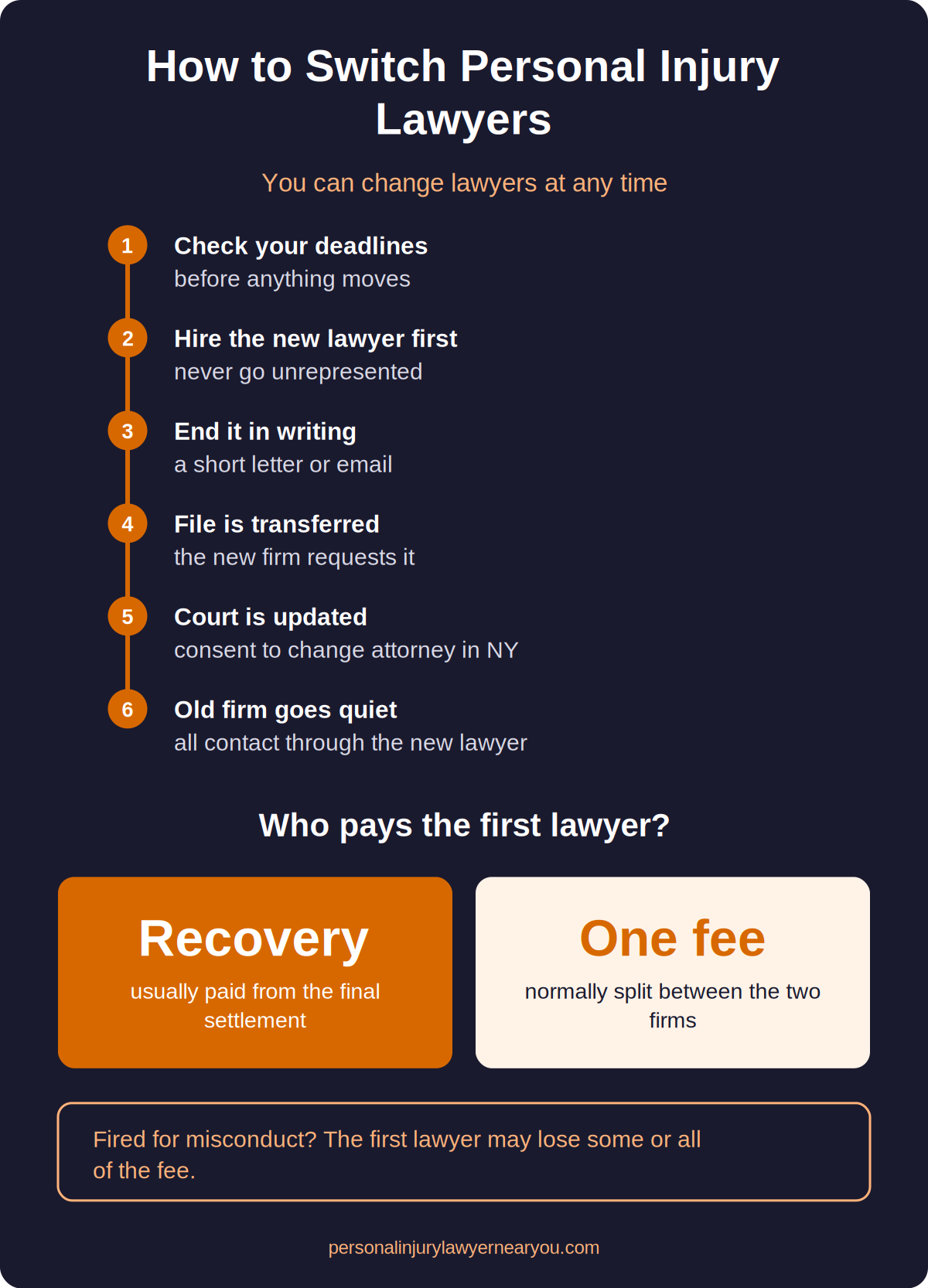
- 1. Hire the new lawyer first. Never leave yourself unrepresented mid-claim. Use the same care you would for a first hire — our guide on how to find a personal injury lawyer covers what to look for.
- 2. Sign the new retainer. Make sure it explains how the old lawyer’s fee will be handled.
- 3. End the old relationship in writing. A short, polite letter or email is enough. Often the new lawyer sends it for you.
- 4. Get your file transferred. The new firm requests it directly. You do not have to collect it yourself.
- 5. Update the court if a lawsuit is pending. In New York this is usually a signed consent to change attorney, or a court order if the old lawyer will not sign.
- 6. Stop talking to the old firm about the case. Send any calls or letters to your new lawyer.
Who Pays the First Lawyer?
This is the question that keeps most people from switching — and the answer is usually better than they fear.
| Situation | What the first lawyer usually gets |
|---|---|
| Fired without cause (you just want someone else) | The reasonable value of the work already done, paid from the final recovery |
| Fired for cause (misconduct, abandonment) | May lose some or all of the fee |
| Case is lost or recovers nothing | Usually no fee — the contingency never happened |
| Expenses the first lawyer paid | Generally repaid from the recovery, as the original agreement provides |
In practice, the two firms usually divide one contingency fee between them, so your total fee stays roughly where it was. In New York, the outgoing lawyer’s claim is protected by a lien on the eventual recovery, which is why the file transfer rarely becomes a standoff. For how the percentages work in the first place, see our guide to personal injury lawyer fees in New York.
Can You Fire Your Lawyer and Represent Yourself?
You can, but it is rarely a good trade. You would be negotiating alone against a professional adjuster, managing deadlines and evidence yourself, and — if a lawsuit is filed — following court procedure without help. The old lawyer may also still claim a fee for work already done, so going solo does not always save as much as people expect.
Timing: Earlier Is Easier
You can switch lawyers at almost any stage, but it gets harder as the case matures. Close to trial, a new lawyer needs time to learn the file, and some firms will not take a case they cannot prepare properly. Switching right after rejecting a settlement offer can also make new lawyers cautious. If something feels wrong, raise it early.
Can I Fire My Personal Injury Lawyer in the Middle of a Lawsuit?
Yes — but once a case is in court, the switch has a few extra steps. People who ask “can I fire my personal injury lawyer after the lawsuit is filed?” are usually worried the court will not allow it. In practice, courts expect clients to change lawyers from time to time, and the process is routine.
How the change is made official
In New York, the simplest route is a consent to change attorney signed by you, the outgoing lawyer and the new lawyer, then filed with the court. If the outgoing lawyer will not sign — often because of a dispute over their fee — the new lawyer can ask the court for an order substituting counsel. The fee disagreement does not usually block the change; it is dealt with separately, often at the end of the case.
What can make a judge hesitate
Timing. A switch on the eve of trial may lead the court to deny a delay, which means the new lawyer must be ready on the existing schedule. That is the main reason to act early if the relationship is not working.
A simple termination letter
Keep it short and neutral. Something like: “Please accept this letter as notice that I am ending your representation in my personal injury matter, effective today. My new attorney, [name and firm], will contact you to arrange the transfer of my file. Please do not take any further action on my behalf.” There is no need to explain your reasons or argue about past problems in writing — your new lawyer will handle any discussion about fees.
So, can I fire my personal injury lawyer and keep my case on track? Yes, if the new lawyer is in place first, deadlines are checked, and the paperwork is filed promptly. The case belongs to you, and the court process is built to let you choose who represents you.
Frequently Asked Questions
Can I fire my personal injury lawyer at any time?
Yes. You can discharge your lawyer at any point in the case, with or without a reason. If a lawsuit has already been filed, the change also has to be recorded with the court, usually through a signed substitution form or a court order.
Do I have to pay my old lawyer if I switch?
Usually not out of your own pocket. A lawyer fired without good cause is normally entitled to the reasonable value of the work already done, which is typically paid out of the final recovery and often shared with the new lawyer’s fee.
Will switching lawyers cost me more in total fees?
Usually not. In most cases the old and new lawyers divide one contingency fee between them rather than each taking a full percentage. Ask your new lawyer to confirm in writing how the old lawyer’s claim will be handled.
How do I fire my personal injury attorney?
Hire your new lawyer first, then send a short written notice ending the old representation. The new lawyer usually handles the rest: requesting your file, dealing with the old lawyer’s fee claim and filing any court paperwork.
Can I fire my personal injury lawyer and represent myself?
Yes, but it is risky. You would deal with the insurer, deadlines, evidence rules and any court procedure alone, and your old lawyer may still claim a fee for work already done. Most people are better served by switching to another lawyer.
Is it too late to change lawyers?
It is rarely too late legally, but switching close to trial or a key deadline is harder. A new lawyer needs time to learn the file, and some will not take a case very late. If you are unhappy, act sooner rather than later.
Key Takeaways
✅ You can fire your personal injury lawyer at any time, for any reason
✅ Hire the new lawyer first, then end the old relationship in writing
✅ The old lawyer is usually paid from the recovery — not by you directly
✅ Check every deadline before you switch
✅ Switching early is far easier than switching on the eve of trial
Unhappy With Your Lawyer? Get a Second Opinion
You do not have to decide alone. A free personal injury consultation can tell you whether your case is being handled properly — and, if you do switch, how the change would work and what it would cost you.
Thinking of Switching Lawyers? Talk to Us First
Free case review. No win, no fee. No upfront cost.
Want more NYC injury guides and legal news from PILNY in your Google results?
