
TL;DR — Quick Summary
A personal injury claim denied by an insurer is often the start of a negotiation, not the end. Get the denial in writing with the exact reason, fix what can be fixed (missing records, late notice, disputed fault), and send a written response with evidence. In New York, a no-fault denial can go to arbitration, unfair handling can be reported to the Department of Financial Services, and a liability denial can be answered with a lawsuit. The lawsuit deadline keeps running the whole time.
Getting your personal injury claim denied feels final. The letter is formal, the language is confident, and it often arrives just when the bills are piling up. But insurers deny claims for many reasons, and a good number of those reasons can be challenged, fixed or simply proven wrong.
This guide covers why injury claims get denied, how to read the letter, and the practical steps to take next in New York.
Why Personal Injury Claims Get Denied
| Common denial reason | What it usually means |
|---|---|
| Disputed liability | The insurer says its driver or customer was not at fault |
| Late notice | The claim or no-fault application was filed after a deadline |
| Gaps in treatment | A delay in seeing a doctor lets the insurer argue the injury came from something else |
| Pre-existing condition | The insurer blames an older injury instead of the accident |
| Not medically necessary | A no-fault insurer refuses to pay for some treatment |
| No coverage | The policy lapsed, an exclusion applies, or the wrong policy was claimed |
| Missing documents | Records, bills or proof of lost wages were never sent |
Notice the pattern: most denials are about proof and timing, not about whether you were really hurt. That is why the response is usually more evidence, sent in writing, before a deadline.
First, Read the Denial Letter Closely
The letter should state the specific reason and, for a policy-based denial, the policy language the insurer relies on. Check three things:
- Which insurer and which coverage. A denial of no-fault benefits from your own insurer is a different fight from a liability denial by the other driver’s insurer.
- The exact reason. “Insufficient documentation” can be fixed. “No coverage on the date of loss” may point you to another policy.
- Any deadline to respond, request reconsideration or demand arbitration.
If no reason is given, ask for it in writing. Vague denials are easier to challenge than specific ones.
7 Steps to Take After an Injury Claim Is Denied
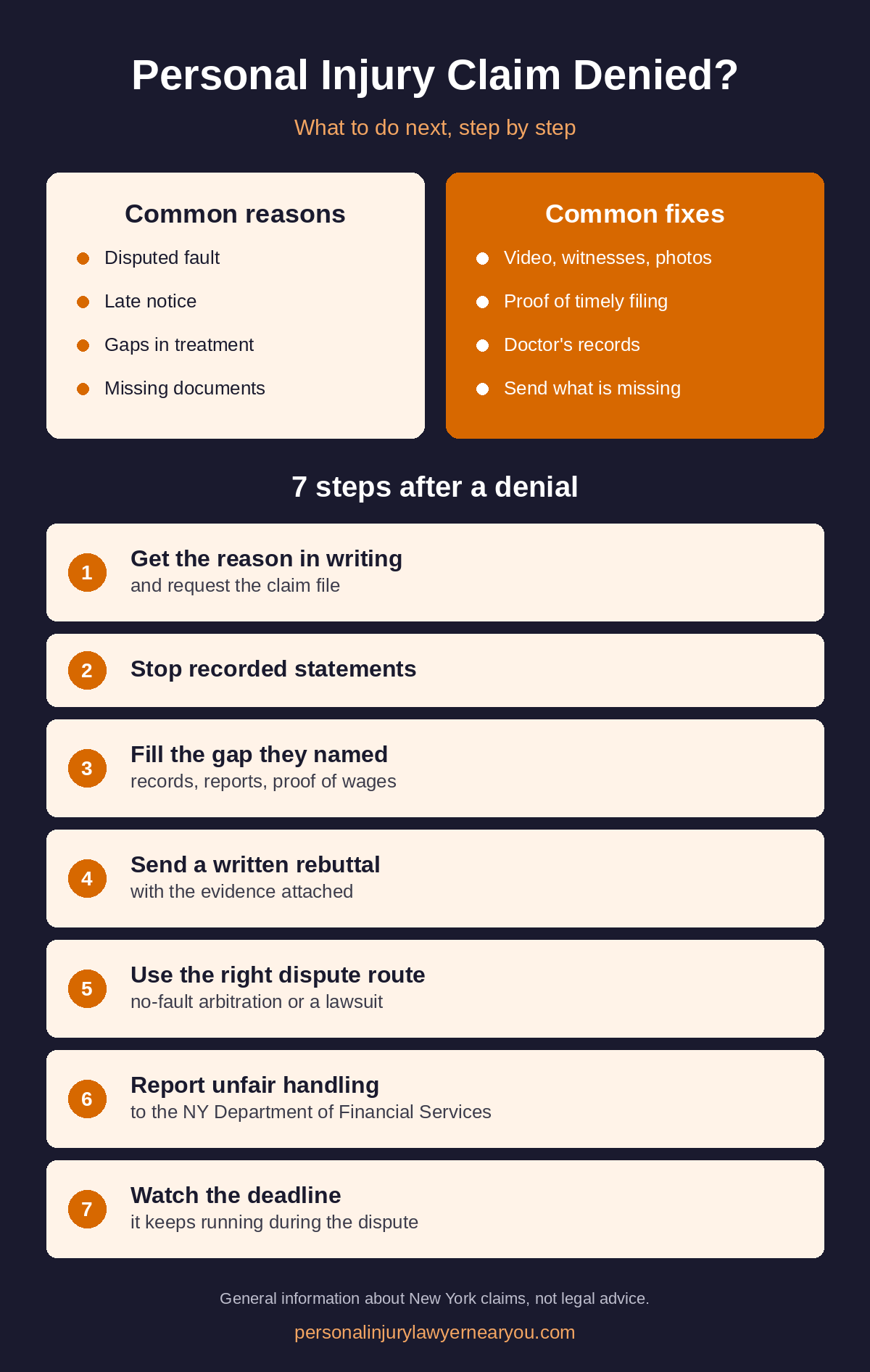
- Get everything in writing. Request the full claim file and the reason for denial.
- Stop giving recorded statements. Anything new you say can become another reason to deny. Learn what not to say to an insurance adjuster.
- Fill the gap the insurer named. Missing medical records, a police report, photos, witness statements or proof of lost wages.
- Send a written response that answers the stated reason point by point and attaches the evidence.
- Use the formal dispute route that fits the denial type (see the table below).
- Report unfair handling. In New York you can file a complaint with the Department of Financial Services if an insurer is not handling a claim fairly or promptly.
- Watch the lawsuit deadline. A denial does not pause the clock. Most New York injury lawsuits must be filed within three years, and claims against a public body need a notice of claim within 90 days.
Which Dispute Route Fits Your Denial
| Type of denial | Usual next step |
|---|---|
| No-fault (your own insurer after a car crash) | Ask the insurer to review the denial (optional), then no-fault arbitration or a lawsuit for the unpaid benefits |
| Liability (the other side’s insurer) | Written rebuttal with evidence, then a lawsuit before the deadline |
| Uninsured or hit-and-run driver | A claim on your own UM coverage, or MVAIC if no policy applies |
| Claim against the City or a public authority | A notice of claim within 90 days, then a lawsuit within one year and 90 days |
| Unfair or slow handling | A complaint to the NY Department of Financial Services |
No-fault denials are the most common after a car crash, often because the application arrived after the 30-day deadline or the insurer says the treatment was not medically necessary. Our guide to New York no-fault insurance explains the deadlines that trigger most of these denials.
When a Liability Denial Means It Is Time to Sue
When the other side’s insurer denies liability outright, it is effectively saying: prove it in court. That is not unusual. Many cases settle only after a lawsuit is filed, once the insurer sees the evidence and the cost of defending the case. Our overview of how long you have to file a personal injury claim in New York lists every deadline that can apply.
Can You Handle the Challenge Yourself?
A simple documentation denial on a small claim can often be fixed on your own. Once an insurer disputes fault, causation or the seriousness of your injury, the work starts to look like litigation. If you are weighing it up, see whether you can handle a personal injury claim without a lawyer, and if you were hurt in Brooklyn, a Brooklyn personal injury lawyer can review the denial for free.
Frequently Asked Questions
What should I do if my personal injury claim is denied?
Get the denial and the reason in writing, stop giving recorded statements, gather the evidence that answers the stated reason, and send a written response. Then use the dispute route that fits the denial, such as no-fault arbitration or a lawsuit, before your deadline runs out.
Why do insurance companies deny injury claims?
The most common reasons are disputed fault, late notice, gaps in medical treatment, pre-existing conditions, treatment the insurer says was not necessary, lapsed coverage and missing documents. Most of these are about proof and timing rather than whether you were hurt.
Can I appeal a denied no-fault claim in New York?
Yes. A denied no-fault claim can be challenged through no-fault arbitration or in court. Ask the insurer for its written reason first, because many no-fault denials turn on deadlines or a dispute over whether treatment was medically necessary.
Does a denial stop the statute of limitations?
No. The deadline to file a lawsuit keeps running while you argue with the insurer. Most New York injury lawsuits must be filed within three years, and claims against a public body need a notice of claim within 90 days.
Can I complain about an insurance company in New York?
Yes. You can file a complaint with the New York State Department of Financial Services if you believe an insurer handled your claim unfairly or too slowly.
Is a denied claim worth pursuing?
Often it is. A denial is frequently the insurer’s opening position, especially on liability. If your injuries are documented and someone else was at fault, a written challenge or a lawsuit can change the outcome.
Key Takeaways
✅ A denial is often an opening position, not a final answer
✅ Get the exact reason for the denial in writing
✅ Most denials turn on proof and timing, so answer them with evidence
✅ No-fault denials can go to arbitration; liability denials can go to court
✅ The lawsuit deadline keeps running while you dispute the denial
Claim Denied? Get a Second Opinion
Insurers count on people accepting the first no. A free case review looks at the denial letter, the reason given and the deadlines still open, and tells you whether the claim can be revived.
Personal Injury Claim Denied? Find Out If It Can Be Fixed
Free case review. No win, no fee. No upfront cost.
Want more NYC injury guides and legal news from PILNY in your Google results?
