
TL;DR — Quick Summary
Personal injury is harm to your body, mind or emotions caused by someone else, as opposed to damage to your property. A personal injury case is the civil claim for compensation that follows. To have a real case you generally need four things: someone owed you a duty of care, they breached it, that breach caused your injury, and you suffered real losses. Car crashes, slip and falls, dog bites, workplace injuries, defective products, medical malpractice and wrongful death are the most common types. In New York, most claims must be filed within three years.
What is considered personal injury? In everyday terms, it is any physical, mental or emotional harm someone suffers because another person or business did something careless or wrong. In legal terms, it is also the name for the civil claim you bring to be paid for that harm. A broken wrist from a fall on an icy store entrance counts. So does whiplash from a rear-end crash, a dog bite, or anxiety that keeps you off the road after an accident.
What does not count is just as important. A dented car on its own is property damage. A contract dispute, a bad haircut with no injury, or a loss with nobody at fault is not a personal injury case. Below we cover the legal definition, the main types of cases, what a claim needs to succeed, and how New York handles it.
What Is Considered Personal Injury Under the Law?
Personal injury law, also called tort law, lets an injured person recover money from whoever wrongfully caused the harm. “Injury” in this sense is broad. It covers:
- Physical injuries: fractures, cuts, burns, head and spine injuries, internal injuries, scarring.
- Psychological injuries: anxiety, depression or post-traumatic stress triggered by the event.
- Emotional harm: pain and suffering, loss of enjoyment of life, humiliation from disfigurement.
- Fatal injuries: when a death is caused by wrongdoing, the family can bring a wrongful death claim.
The harm has to come from another party’s conduct. That conduct is usually negligence (carelessness), sometimes an intentional act like an assault, and in some product cases strict liability, where a manufacturer is responsible for a dangerous defect even without proof of carelessness. The compensation itself is broken into categories explained in our guide to personal injury damages.
What Is a Personal Injury Case? The Four Elements
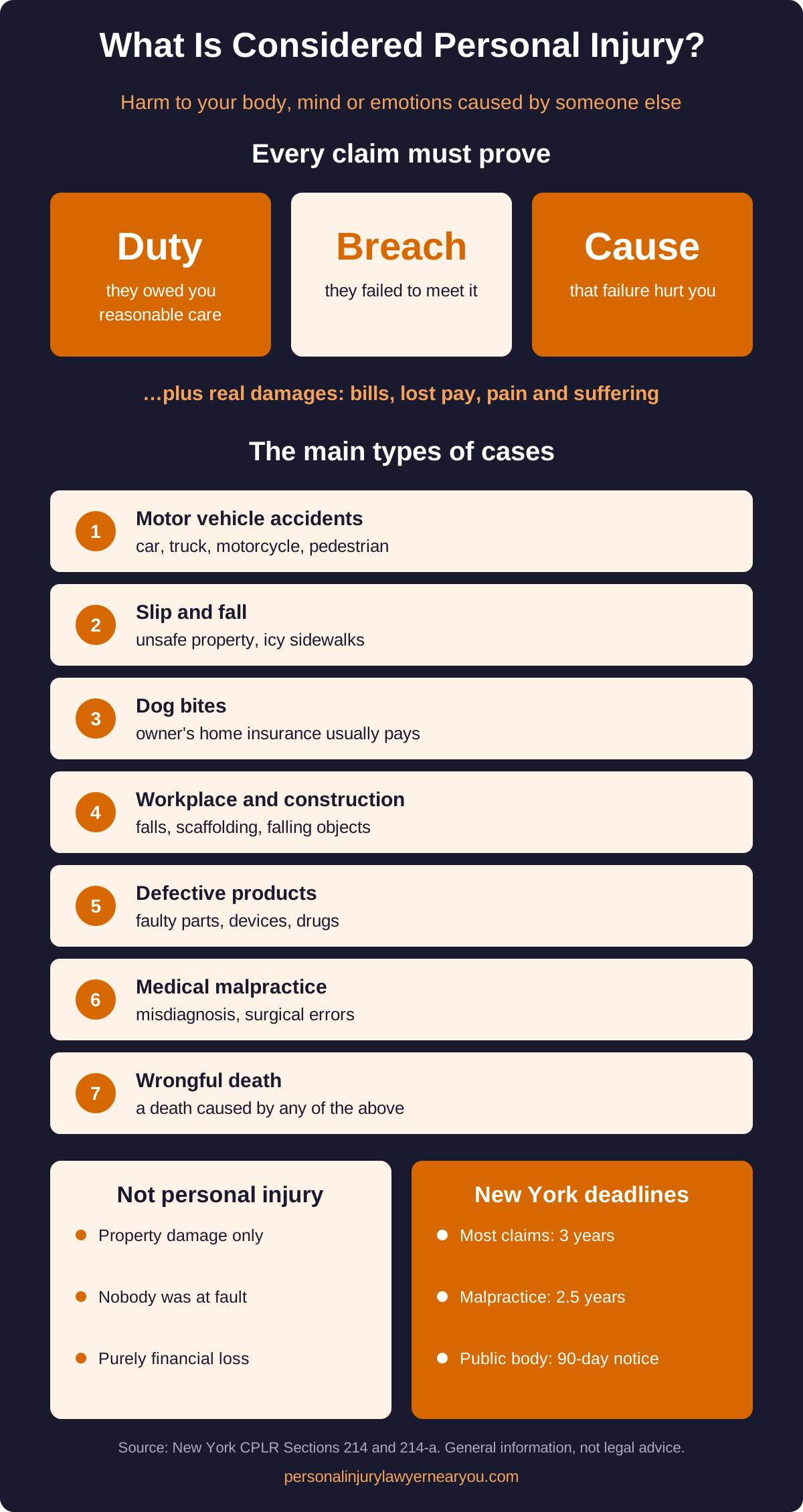
Being hurt is not enough on its own. For most negligence claims you have to prove four elements:
| Element | What it means | Example (rear-end crash) |
|---|---|---|
| Duty | The other party owed you reasonable care | Every driver must drive safely around others |
| Breach | They failed to meet that standard | The driver was texting and didn’t brake |
| Causation | The breach caused your injury | The impact caused your neck injury |
| Damages | You suffered real, provable losses | Medical bills, missed work, pain and suffering |
If any one of these is missing, there is usually no case. A store that mopped the floor and put up a wet-floor sign may not have breached its duty. A crash that caused no injury has no personal injury damages. This is also why lawyers ask so many questions at the first meeting — and why it helps to bring your own questions too.
Types of Personal Injury Cases
Personal injury is an umbrella term. These are the categories most lawyers handle, and the full range of services is listed on our practice areas page.
| Type of case | Typical situation | Who usually pays |
|---|---|---|
| Motor vehicle accidents | Car, truck, motorcycle, rideshare, pedestrian and bicycle crashes | The driver’s auto insurer; in NY, your own no-fault coverage first |
| Slip and fall / premises liability | Wet floors, broken stairs, icy sidewalks, poor lighting | The property owner’s liability insurer |
| Dog bites | A dog with known aggressive tendencies bites or knocks someone down | The owner’s homeowners or renters insurance |
| Workplace and construction | Falls from height, scaffolding, falling objects | Workers’ comp, plus third parties in some cases |
| Defective products | Faulty car parts, dangerous devices, contaminated food or drugs | The manufacturer or seller |
| Medical malpractice | Misdiagnosis, surgical errors, medication mistakes | The provider’s malpractice insurer |
| Wrongful death | A death caused by any of the above | Whoever was liable for the fatal injury |
Motor vehicle accidents
The most common personal injury case by far. In New York, car accident claims also run through the no-fault insurance system before you can sue the at-fault driver for pain and suffering, and only for injuries that meet the state’s “serious injury” threshold. Our Brooklyn car accident lawyer page explains how that works locally.
Premises liability
Property owners and tenants must keep their premises reasonably safe. Claims arise from slippery floors, broken handrails, uneven sidewalks, inadequate security and similar hazards. The key question is usually whether the owner knew or should have known about the danger.
Truck and commercial vehicle crashes
These look like car accidents but often involve bigger injuries, more defendants (the driver, the trucking company, a maintenance contractor) and federal safety rules. A Staten Island truck accident lawyer, for example, will look at driver logs and maintenance records that do not exist in a typical car crash.
What Counts as a Catastrophic Personal Injury?
Catastrophic personal injury law deals with injuries that permanently change a person’s life or ability to work. Common examples include:
- Traumatic brain injury
- Spinal cord injury and paralysis
- Amputation or loss of a limb
- Severe burns and disfigurement
- Loss of sight or hearing
- Multiple fractures needing repeated surgery
These cases are valued very differently. They include the cost of lifetime medical care, home modifications and lost earning capacity over decades, which is why they produce many of the largest verdicts and settlements. They are also the cases most likely to be fought hard — and among the few that actually reach a courtroom, since most ordinary injury claims settle long before trial.
What Is Not Considered Personal Injury?
Some situations feel like an injury but do not fit a personal injury claim:
- Property damage only. A damaged car or phone with no bodily harm is a property claim, not a personal injury claim.
- Nobody at fault. If you trip on your own shoelace or are hurt in a true accident that no one could have prevented, there is no one to claim against.
- Purely financial loss. Losing money in a bad deal is a contract or business matter.
- Workplace injury against your own employer. In most cases this goes through workers’ compensation instead of a lawsuit against the employer, though a separate claim against a third party may still be possible.
- Injuries you caused yourself. If you were mostly at fault, your recovery may be reduced or eliminated depending on the state’s fault rules.
What Is a Personal Injury Claim Worth?
There is no fixed amount. Value depends on how serious the injury is, how clear liability is, how much the treatment cost, how long recovery takes, and how much insurance is available. A soft-tissue injury that heals in weeks and a spinal injury that needs surgery are both “personal injury,” but they are worth very different amounts.
For a first estimate based on your own medical bills and lost wages, try the personal injury settlement calculator. It gives a rough range, not a guarantee, but it is a useful starting point before you speak to anyone.
Deadlines: How Long You Have in New York
Every personal injury claim has a filing deadline, called the statute of limitations. Under New York CPLR Section 214, most personal injury lawsuits must be filed within three years of the injury. Some claims run on very different clocks:
| Type of claim (New York) | Typical deadline |
|---|---|
| Most negligence claims (car crashes, slip and falls, dog bites) | 3 years |
| Medical malpractice | 2 years and 6 months |
| Wrongful death | 2 years from the date of death |
| Claims against a city or public body | Notice of claim within 90 days |
Miss the deadline and the claim is usually gone for good, no matter how strong it was. If a public bus, a city sidewalk or a government vehicle is involved, act within weeks, not months.
What Is Considered Personal Injury in Your Situation? A Quick Self-Check
Definitions are useful, but most people really want to know whether their situation qualifies. Work through these questions in order.
1. Were you hurt, or was only property damaged?
Any bodily injury, even one that seemed minor at first, can count. Pain that shows up a day or two later is common after crashes, so see a doctor and keep the records. If only your property was damaged, you have a property claim instead.
2. Did someone else cause it?
Think about who controlled the situation: the other driver, the store owner, the landlord, the dog owner, the company that made the product. If someone failed to act with reasonable care and that caused your injury, you may have a claim against them or their insurer.
3. Can you show what it cost you?
Medical bills, pharmacy receipts, missed paychecks and a written record of how the injury affects your daily life all support a claim. Without proof of losses, even clear fault leads to a small recovery.
4. Is there insurance or another source of payment?
Most personal injury claims are paid by insurance: auto, homeowners, business liability or malpractice coverage. A claim against someone with no insurance and no assets may be hard to collect, even if you win.
Keep a simple folder or phone album with every bill, photo and message from the start. It is the single easiest way to strengthen a claim later.
5. Are you still within the deadline?
In New York, most claims must be filed within three years, and claims against public bodies require a notice within 90 days. When in doubt, assume the shorter deadline applies until you confirm otherwise.
If you can answer yes to the first four questions and you are within the deadline, what you went through is very likely considered personal injury under the law. Some people handle small, clear-cut claims themselves — our guide to handling a personal injury claim without a lawyer explains when that makes sense. For anything involving surgery, disputed fault or a public body, a free case review is the safer first step.
Frequently Asked Questions
What is considered personal injury?
Personal injury is any harm to your body, mind or emotions caused by someone else’s carelessness or intentional act, as opposed to damage to your property. In law it covers the civil claim you can bring to be compensated for that harm, such as after a car crash, a fall or a dog bite.
What is a personal injury case?
A personal injury case is a civil claim asking the person or business that caused your injury, usually through their insurance company, to pay for your losses. Most are settled with the insurer; only a small share are decided by a judge or jury.
What cases do personal injury lawyers take?
Most take motor vehicle crashes, slip and falls, dog bites, workplace and construction injuries, defective products, medical malpractice and wrongful death. They look for three things: someone else was at fault, you were genuinely hurt, and there is insurance or assets to pay the claim.
Is emotional distress considered personal injury?
Yes. Emotional and psychological harm, such as anxiety or post-traumatic stress after a crash, is part of a personal injury claim. It is easiest to recover when it comes with a physical injury and is documented by a doctor or therapist.
What is catastrophic personal injury?
A catastrophic injury is one that permanently changes your life or your ability to work, such as a traumatic brain injury, spinal cord injury and paralysis, amputation or severe burns. These cases involve lifetime care costs and are usually the highest-value claims.
How long do you have to file a personal injury claim in New York?
For most personal injury claims in New York, the deadline to file a lawsuit is three years from the date of the injury. Claims against a city or other public body have a much shorter notice deadline, often 90 days, so check your deadline early.
Key Takeaways
✅ Personal injury is physical, mental or emotional harm caused by someone else
✅ A valid case needs duty, breach, causation and real damages
✅ Vehicle crashes, slip and falls, dog bites, defective products and malpractice are the main types
✅ Property damage alone, or an injury nobody caused, is not a personal injury claim
✅ In New York, most claims must be filed within three years
Not Sure If Your Injury Counts?
You don’t have to work it out alone. A free case review will tell you whether what happened is considered personal injury, who may be responsible, and what the claim could be worth.
Hurt in an Accident? Find Out If You Have a Case
Free case review. No win, no fee. No upfront cost.
Want more NYC injury guides and legal news from PILNY in your Google results?
