
TL;DR — Quick Summary
Yes, you can handle a personal injury claim yourself — and for a minor, fully healed injury with clear fault, it can make sense. The process is: finish treatment, gather your records, send a written demand letter, negotiate, and sign a release only when you are sure. It gets risky fast when injuries are serious, fault is disputed, a government body is involved, or a lawsuit is needed. The biggest DIY mistakes are undervaluing pain and suffering, giving recorded statements, and signing a release too early.
Knowing how to file a personal injury claim without a lawyer is useful even if you end up hiring one — it shows you what the work actually involves. Some claims are simple enough to handle alone. Others look simple and are not.
This guide covers when going it alone is reasonable, the step-by-step process, and the points where self-represented claimants most often lose money.
Can You Represent Yourself in a Personal Injury Case?
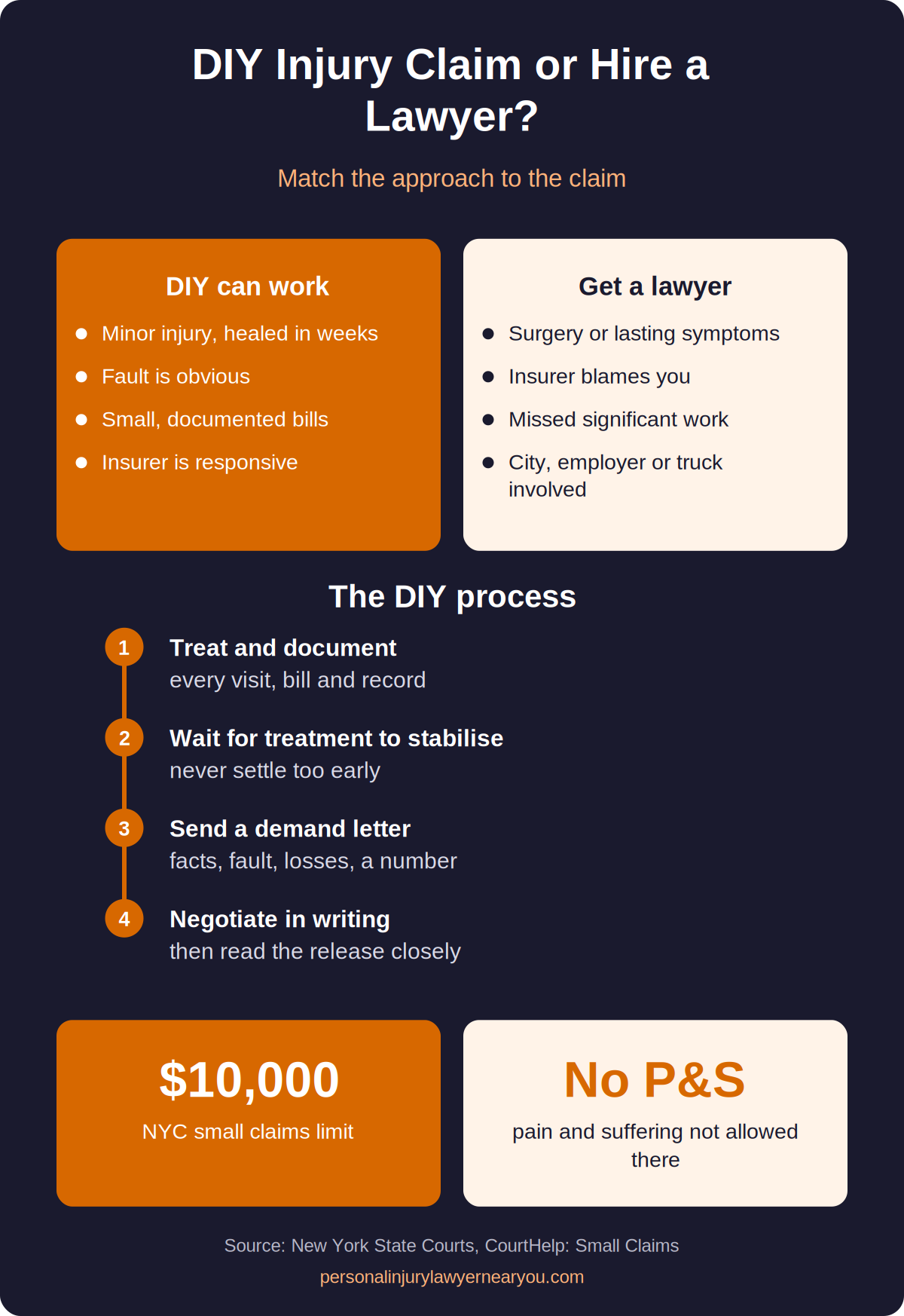
Yes. You have the right to negotiate your own claim with the insurance company and, if needed, to file and argue a lawsuit yourself. The question is not whether you can — it is whether your claim is the kind where doing it yourself leaves money on the table.
| Handling it yourself can work when… | Get a lawyer when… |
|---|---|
| The injury was minor and healed within weeks | You needed surgery, ongoing treatment, or still have symptoms |
| Fault is obvious and not disputed | The insurer blames you, or several parties may share fault |
| Medical bills are small and fully documented | You missed significant work or face future costs |
| The insurer is responsive and reasonable | The insurer stalls, lowballs, or denies the claim |
| Only a private person or business is involved | A city, transit authority, employer or commercial vehicle is involved |
For car crashes specifically, our honest take on whether you should get a lawyer for a car accident walks through the same decision.
How to File a Personal Injury Claim Without a Lawyer
- 1. Get treated and keep every record. Medical records are the backbone of the claim. Gaps in treatment are used to argue you were not really hurt.
- 2. Report the claim to the right insurer. Usually the at-fault person’s liability insurer. In no-fault states like New York, your own policy pays first for medical bills and lost wages.
- 3. Limit what you say. Give basic facts in writing. You do not have to give a recorded statement to the other side’s insurer — here is what not to say to an insurance adjuster.
- 4. Wait until treatment is finished or stable. Settle too early and you cannot go back for costs you did not know about.
- 5. Add up your damages. Medical bills, lost wages, out-of-pocket costs, plus a figure for pain and suffering.
- 6. Send a demand letter. Set out how the accident happened, why the other party is at fault, your injuries and treatment, and a specific amount.
- 7. Negotiate in writing. The first offer is rarely the best one. Respond with reasons, not just a lower number.
- 8. Read the release before you sign. It almost always ends the claim permanently.
Step 5 is where most people undervalue their claim. Our step-by-step guide to calculating a car accident settlement shows how adjusters actually build the number.
What About Small Claims Court?
Small claims court is built for people without lawyers, but it is a poor fit for most injury cases. According to the New York State courts’ small claims guidance, you can sue for up to $10,000 in New York City and less elsewhere in the state — and you cannot sue for pain and suffering there. For anything beyond a small property or out-of-pocket loss, the claim belongs with the insurer or in a regular civil court.
The Biggest Risks of Going It Alone
- Undervaluing pain and suffering. Insurers often pay little more than the medical bills to unrepresented claimants.
- Signing a release too early. If complications appear later, the claim is already closed.
- Missing a deadline. Lawsuit deadlines run for years, but claims against a public body can need a notice within 90 days in New York. See our guide to the personal injury statute of limitations.
- Medical liens. Health insurers and hospitals may have a right to be repaid from your settlement, and the amount is often negotiable.
- No real leverage. An insurer knows a self-represented claimant is unlikely to file suit, so there is less pressure to pay.
Is Handling It Yourself Actually Cheaper?
Not always. Most injury lawyers work on a contingency fee — no upfront cost, and no fee if there is no recovery. The real question is whether a lawyer would increase the settlement by more than the fee. On a small, clear claim, maybe not. On a serious injury, often yes. Our breakdown of personal injury lawyer fees in New York shows the typical percentages.
A middle path is a free consultation before you accept any offer. It costs nothing, and you leave knowing whether the number on the table is fair.
Writing the Demand Letter for a Personal Injury Claim Without a Lawyer
The demand letter is the most important document in a personal injury claim without a lawyer. It is your one chance to set out the whole case in writing before negotiation starts. Keep it factual, organised and backed by documents.
What to include, in this order
- Claim details. Your name, the insured’s name, the claim number and the date and place of the accident.
- What happened. A short, neutral account of the accident and why the other party was at fault — reference the police report or photos.
- Your injuries and treatment. Diagnosis, every provider you saw, and whether you have finished treatment or need more.
- Your losses. An itemised list of medical bills, lost wages and out-of-pocket costs, with totals.
- How the injury affected your life. Specific examples: missed events, help needed at home, sleep, work duties you could not do.
- Your demand. A specific dollar amount, and a reasonable deadline to respond, such as 30 days.
- Attachments. Copies — never originals — of records, bills, pay stubs and photos.
Common demand letter mistakes
- Demanding only your bills. That leaves nothing for pain and suffering or negotiation.
- Exaggerating. One provable overstatement undermines everything else in the letter.
- Sending it too early. If you are still treating, you are guessing at your losses.
- Admitting fault in passing. Phrases like “I didn’t see them” can be used against you.
Send the letter by a method you can prove, keep a copy, and log every response. If the insurer replies with a figure close to your bills alone, or simply ignores the letter, that is the point where a personal injury claim without a lawyer often benefits from a free second opinion.
Frequently Asked Questions
Can I represent myself in a personal injury case?
Yes. You have the right to handle your own claim and even to file and argue a lawsuit yourself. It can work for small, clear-cut claims, but it becomes risky when injuries are serious, fault is disputed or a lawsuit is needed.
How do I settle a personal injury claim without an attorney?
Finish or stabilise your medical treatment, gather your records, bills and proof of lost wages, then send the insurer a written demand letter with a specific amount. Negotiate in writing, and read the release carefully before you sign.
When is it reasonable to handle a claim yourself?
Usually when the injury was minor and fully healed within a few weeks, fault is clear, the medical bills are small, and the insurer is responding fairly. If any of those change, it is worth getting a free legal opinion.
Can I use small claims court for a personal injury in New York?
Small claims courts handle money claims only, up to $10,000 in New York City and lower limits elsewhere in the state. New York’s court guidance says pain and suffering cannot be sought in small claims, so it rarely suits injury cases.
What is the biggest risk of handling a claim without a lawyer?
Undervaluing the claim and signing a release too early. Once you sign, the claim is usually over for good, even if your injury turns out to be worse than you thought. Missing a filing deadline is the other major risk.
Does hiring a lawyer cost money upfront?
Usually not. Most personal injury lawyers work on contingency, taking a percentage of what they recover and charging no fee if you lose. A first consultation is normally free.
Key Takeaways
✅ You can handle your own claim — it suits minor, clear-cut injuries best
✅ Finish treatment before you settle, and put your demand in writing
✅ Small claims court does not cover pain and suffering in New York
✅ A signed release usually ends the claim for good
✅ A free consultation before accepting an offer costs you nothing
Check the Offer Before You Sign
Handling your own claim is your right. But before you sign a release, it is worth a second opinion on whether the number is fair — especially if you are still in pain or missing work. A case review is free and comes with no obligation.
Got an Offer? Find Out If It’s Fair
Free case review. No win, no fee. No upfront cost.
Want more NYC injury guides and legal news from PILNY in your Google results?
