
TL;DR — Quick Summary
The Staten Island Expressway is I-278, a State highway. That means a crash there can run on two entirely separate tracks at once. Against the trucking company: Supreme Court, three years, a jury. Against the State: the Court of Claims, 90 days to file — or serve a Notice of Intention on the Attorney General within those 90 days and you get two years — and no jury at all. Different court, different clock, different decision-maker. Most people never learn the second track existed until it has closed.
A Staten Island Expressway truck accident gets handled like any highway crash. Insurance adjusters, medical treatment, a claim against the carrier. Everything proceeds on the assumption that there is one defendant and one deadline.
On the SIE that assumption is frequently wrong, and the cost of it is total — because one of the two clocks runs out in ninety days.
Why the SIE Is Different From a City Street
The Staten Island Expressway carries Interstate 278 across the island — the only continuous route between the Goethals Bridge on the western shore and the Verrazzano-Narrows on the eastern. Every truck travelling between New Jersey and Brooklyn by road uses it. There is no alternative.
It is also a State highway, maintained by the New York State Department of Transportation — not by New York City. Hylan Boulevard is a City street. Richmond Avenue is a City street. The SIE is not, and neither is the West Shore Expressway.
This is a distinction people cross a dozen times a week without noticing, and it decides which court hears your case.
Two Tracks, Running Side by Side
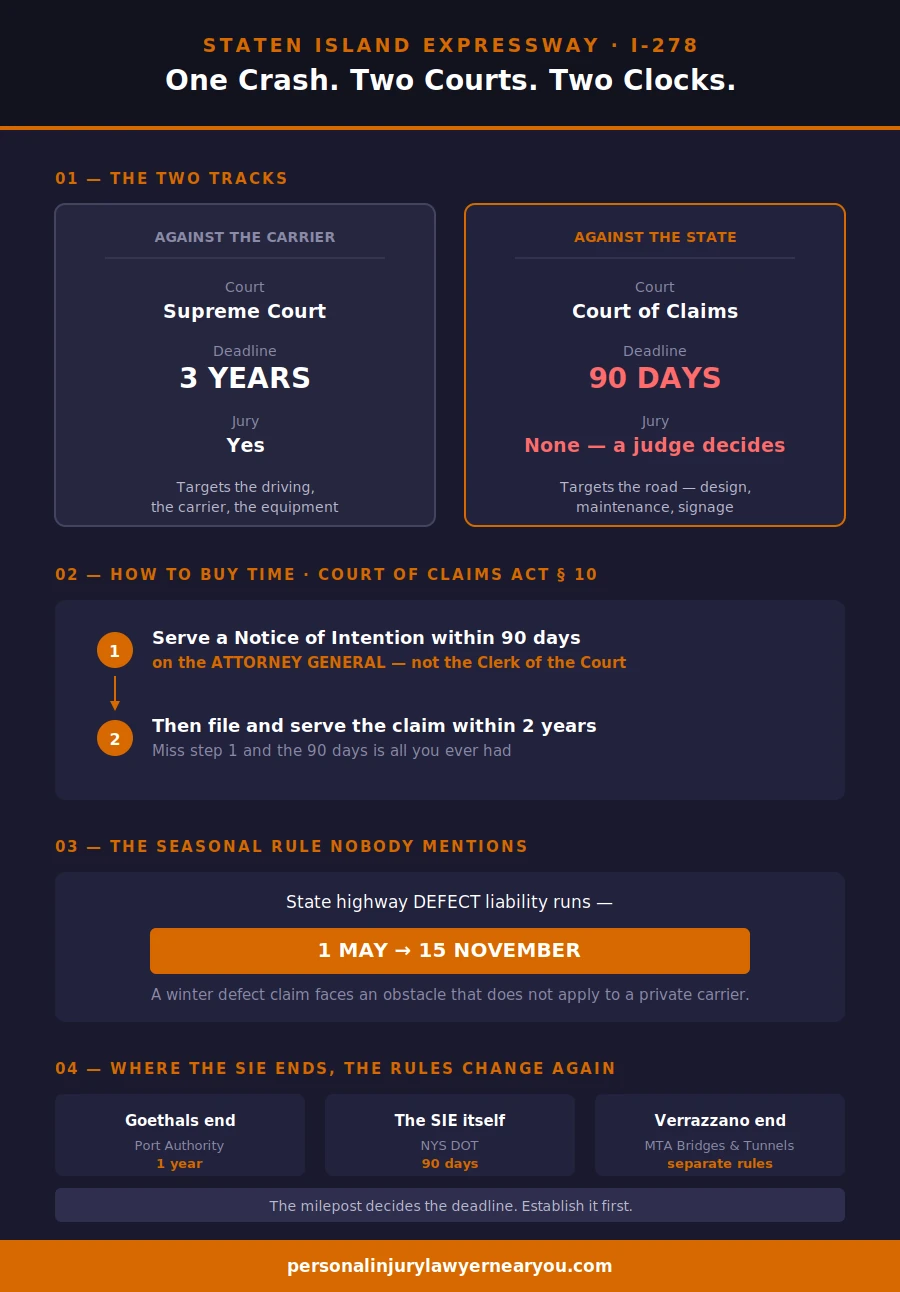
If the truck driver alone caused the crash, you have one claim against a private company. But where the roadway contributed — a defect, missing or obscured signage, a poorly designed merge, inadequate barriers, standing water — the State becomes a defendant, and that claim behaves nothing like the first.
| Against the trucking company | Against the State of New York | |
|---|---|---|
| Court | Supreme Court | Court of Claims |
| Deadline | 3 years | 90 days to file and serve the claim — or serve a Notice of Intention within 90 days and file within 2 years |
| Jury | Yes | No — a judge decides |
| Served on | The company | The Attorney General — plus any other State entity involved |
| What it targets | The driving, the carrier, the equipment | The road — design, maintenance, signage, condition |
The two rows that matter most are the deadline and the jury. Ninety days against three years is an enormous gap, and losing the right to a jury changes how a case is valued from the first day.
The Notice of Intention Is Not Filed With the Court
This trips up people who assume it works like a City Notice of Claim. It does not.
Under the Court of Claims Act § 10, a personal injury claim based on negligence must be filed and served within 90 days after it accrues — unless within that same 90 days you serve a written Notice of Intention on the Attorney General, in which case the claim must be filed and served within two years.
The Court of Claims is explicit that a Notice of Intention is not filed with the Clerk of the Court — it is the act of serving the Attorney General that extends the time. And where a State entity other than the State itself is a defendant, that entity must be served with the Notice of Intention as well.
So the mechanism is a two-step: serve the Notice of Intention within 90 days to buy time, then file the actual claim within two years. Miss the first step and the 90 days is all you ever had. There is a narrow safety valve — a claimant who timely served a Notice of Intention but failed to timely file may apply to have the notice treated as the claim — but it is a motion, not a right, and it depends on the notice having been served properly in the first place.
The Seasonal Rule Nobody Mentions
There is a feature of State highway claims that catches winter crashes specifically, and it is worth knowing about before you assume a road-defect claim is available.
New York State’s own claim guidance for highway damage reflects that liability for defects in State highways runs between 1 May and 15 November. Outside that window, a defect-based claim against the State faces a statutory obstacle that does not exist against a private defendant.
The SIE climbs and falls across the island, and winter conditions there are genuinely worse than on flat City streets. A December crash caused by a pothole or a failed surface is exactly the scenario this rule affects — and it is one more reason the claim against the carrier is never something to set aside while the State claim is explored. The two must run together.
Why the SIE Concentrates Truck Crashes
Three things stack on this road at once.
It is a forced corridor. Freight moving between New Jersey and Brooklyn has no realistic alternative, so heavy vehicles concentrate here in a way they do not elsewhere in the city. Most of that traffic has neither an origin nor a destination on Staten Island — it is passing through, which brings the through-route obligations discussed in our post on truck route violations into play.
It has heavy grade changes across the island’s spine, which matters enormously for loaded trucks — braking distances lengthen going down, and speed differentials open up going up.
And it funnels straight onto bridges at both ends. Where the crash sits in relation to those approaches decides everything, because the bridges belong to different authorities again — the Port Authority at one end and MTA Bridges and Tunnels at the other, each with its own deadline. Our post on Staten Island bridge truck accidents covers those rules, and they are shorter still.
What to Establish in the First Weeks
| What to establish | Why it matters |
|---|---|
| Exact milepost and direction | Decides whether you are on State highway, a bridge approach, or a City ramp |
| Road surface and signage condition | The entire basis of any State claim — and it gets repaired |
| Prior complaints or work orders | Goes to notice — whether the State knew about the defect |
| Which police agency responded | NYPD and State Police generate different reports and different retention |
| The carrier’s USDOT number | Opens the private track, which runs on its own three-year clock |
| Date and weather | Determines whether the seasonal highway defect window applies |
The second row is the urgent one. State DOT repairs defects — that is its job — and once the surface is fixed, the condition that caused your crash exists only in whatever photographs somebody thought to take. The general first-steps sequence is covered in our guide on what to do after a truck accident in New York.
The New York Rules That Still Apply
Whichever track your case runs on, the underlying framework does not change. You have 30 days to file your no-fault application. The serious injury threshold under Insurance Law § 5102(d) governs pain and suffering in a motor vehicle case. Comparative negligence reduces recovery by your share of fault, and under the 2026 reform a plaintiff found mostly at fault cannot recover non-economic damages at all. Our free settlement calculator gives you a working range before any figure is discussed.
Frequently Asked Questions
Who is responsible for maintaining the Staten Island Expressway?
The Staten Island Expressway carries Interstate 278 and is a State highway maintained by the New York State Department of Transportation, as is the West Shore Expressway. Local roads such as Hylan Boulevard and Richmond Avenue are City streets under NYC DOT, and the bridges at either end belong to the Port Authority and MTA Bridges and Tunnels respectively.
How long do I have to bring a claim against New York State?
Under Court of Claims Act § 10, a personal injury claim based on negligence must be filed and served within 90 days after accrual, unless a written Notice of Intention is served on the Attorney General within those 90 days — in which case the claim must be filed and served within two years of accrual.
Where do I file a Notice of Intention?
It is not filed with the Clerk of the Court. The Court of Claims is explicit that service upon the Attorney General is the act that extends the period in which to serve and file the claim. Where a State entity other than the State is a defendant, that entity must be served with the Notice of Intention as well.
Will a jury hear my case against the State?
No. Claims against the State of New York are heard in the Court of Claims, where a judge decides both liability and damages. A claim against a private trucking company proceeds in Supreme Court, where a jury is available. Where both defendants are involved, the two claims proceed separately in different courts.
Does it matter what time of year my crash happened?
It can, for a claim based on a highway defect. New York State’s own guidance on highway damage claims reflects that liability for defects in State highways runs between 1 May and 15 November. A defect claim arising outside that window faces an obstacle that does not apply to a claim against a private carrier, which is one reason both tracks should be pursued rather than one.
What if I only sue the trucking company?
That claim is unaffected and runs on the ordinary three-year period. But if a road defect or signage failure contributed and the State is never brought in, that portion of the responsibility has no defendant attached to it. Because the State’s window closes at 90 days, the decision has to be made early rather than after the investigation is complete.
Key Takeaways
✅ The SIE is I-278, a State highway — not a City street
✅ State claims go to the Court of Claims: 90 days, and no jury
✅ A Notice of Intention is served on the Attorney General, not filed with the Clerk
✅ Serve it within 90 days and you get two years to file the claim
✅ Highway defect liability runs 1 May to 15 November — winter is different
Do Not Let the Shorter Clock Run Out
The claim against the trucking company will still be there in two years. The claim against the State will not — it closes at ninety days unless a Notice of Intention is served, and almost nobody serves one because almost nobody is told it exists. Speak to a Staten Island truck accident lawyer while both tracks are still open. The framework is the same as any Staten Island personal injury claim, with a second defendant on a much shorter timeline. The case review is free, and there is no fee unless you win.
Talk to a Staten Island Truck Accident Lawyer Today
Free case review. No win, no fee. No upfront cost.
Want more NYC injury guides and legal news from PILNY in your Google results?
