
TL;DR — Quick Summary
After a Bronx accident, the insurance adjuster who calls you sounds friendly — but their job is to pay you as little as possible, and they are trained to use your own words against you. What not to say to an insurance adjuster comes down to five phrases: “I’m sorry,” “I’m fine,” “I think/maybe,” “yes, you can record me,” and “yes, I’ll accept that offer.” Each one can quietly gut your claim under New York’s comparative fault rules. This guide breaks down why — and exactly what to say instead.
Here’s something the insurance company will never tell you: the adjuster who calls after your Bronx accident is a trained negotiator whose entire job is to reduce what they pay you. They will be polite. They will sound like they’re on your side. And they are documenting every word you say to find a reason to shrink your claim. Knowing what not to say to an insurance adjuster is one of the most important things you can do to protect your case — before a single friendly sentence costs you thousands. It’s also one of the first things a Bronx personal injury claim lawyer handles for you.
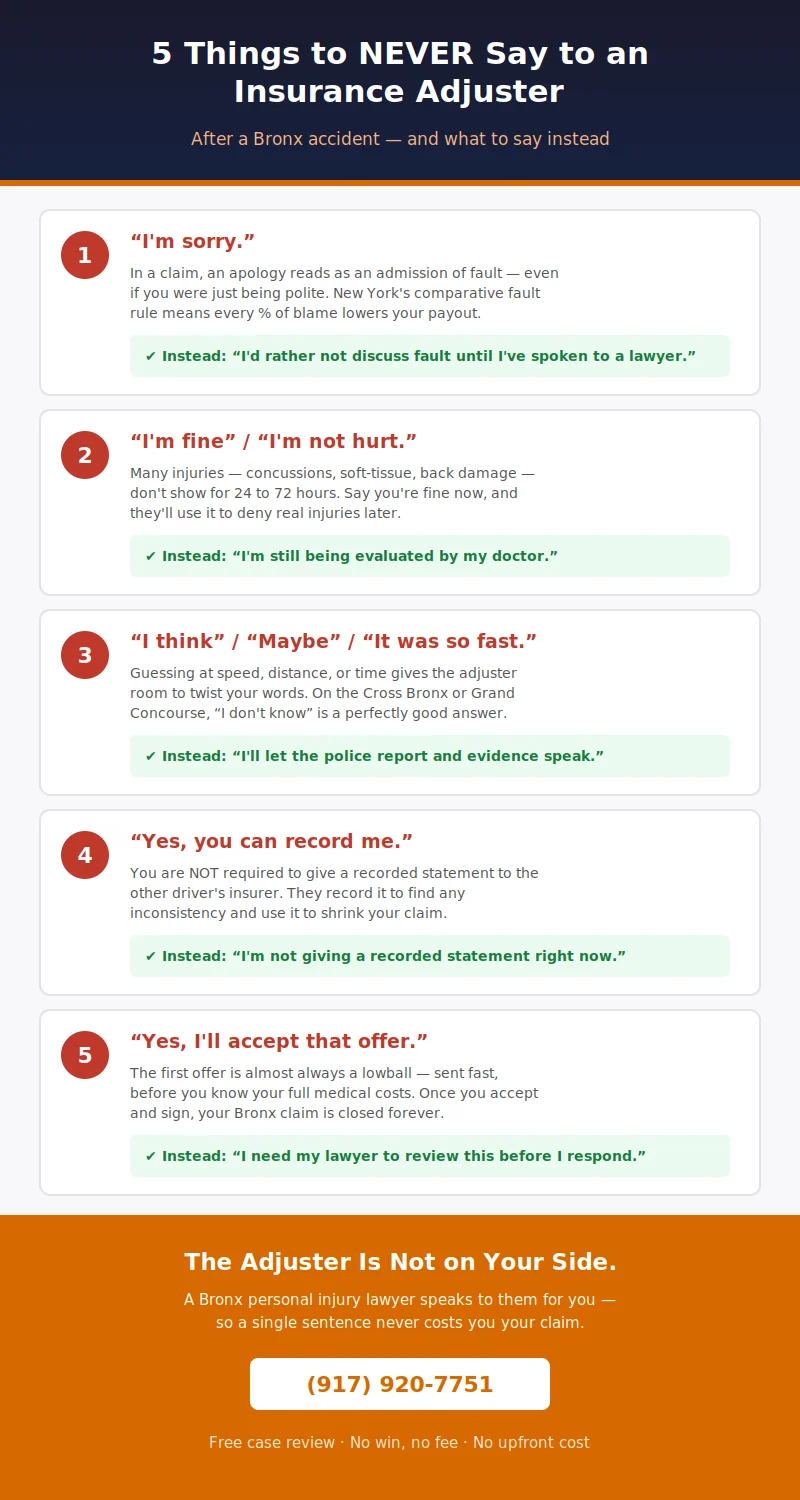
Here are the five phrases to never say after a Bronx crash or injury — and what to say instead.
1. “I’m Sorry”
In everyday life, “I’m sorry” is basic politeness. In an insurance claim, it’s treated as an admission of fault. This matters enormously in New York, which follows a comparative fault rule — your compensation is reduced by whatever percentage of blame is assigned to you. If the adjuster can use your apology to pin even 20% of the fault on you, your payout drops by 20%. Never apologize, even reflexively.
Say instead: “I’d rather not discuss who was at fault until I’ve spoken with a lawyer.”
2. “I’m Fine” or “I’m Not Hurt”
This is the trap that catches the most people. Right after an accident, adrenaline masks pain, and many serious injuries — concussions, soft-tissue damage, spinal injuries — don’t show symptoms for 24 to 72 hours. If you tell the adjuster you’re “fine” in that first call, they will use it to deny or minimize the injuries that surface days later. You cannot know the full extent of your injuries until a doctor evaluates you, which is why getting medical care immediately after a Bronx accident protects both your health and your claim.
Say instead: “I’m still being evaluated by my doctor, so I can’t discuss my injuries yet.”
3. “I Think…” or “Maybe…” or “It Happened So Fast”
Adjusters love a guess. If you speculate about your speed, the distance, or exactly how the crash unfolded on the Cross Bronx Expressway or Grand Concourse, they can twist that guess into an argument that you were careless. You are under no obligation to fill in gaps in your memory. “I don’t know” is a perfectly acceptable — and safe — answer. Stick to the basic facts: date, time, location, vehicles involved.
Say instead: “I’m not going to speculate. I’ll let the police report and the evidence speak for themselves.”
4. “Yes, You Can Record Me”
Early in the process, the adjuster will often ask to record a statement. Here’s what they won’t tell you: you are not legally required to give a recorded statement to the other driver’s insurance company. They record it specifically to catch any small inconsistency between what you say now and what you say later — then use it to question your credibility and reduce your claim. Adjusters also compare what you say with social media and surveillance video, the same tools they use to spot exaggerated personal injury claims. Politely decline until you have a lawyer.
Say instead: “I’m not comfortable giving a recorded statement right now.”
5. “Yes, I’ll Accept That Offer”
The first settlement offer is almost always a lowball — and it comes fast, often before you even know the full cost of your medical treatment. Insurers count on you being stressed, in pain, and worried about bills, so you’ll grab the quick money. But once you accept and sign a release, your claim is closed forever — even if your injuries turn out to be far more serious and expensive than that first offer covered. Knowing how much a Bronx injury claim is really worth is the best defense against a lowball.
Say instead: “I need to have my lawyer review this before I respond to any offer.”
Why Knowing What Not to Say to an Insurance Adjuster Matters
None of this means the adjuster is a bad person. It means they have a job — and their job is the opposite of yours. You want full and fair compensation; they are measured on how little the company pays out. Every friendly question (“So how are you feeling today?”) has a purpose. That’s the entire reason having a lawyer handle communication is so powerful: the adjuster can no longer fish for damaging statements, because they have to go through someone who knows every trick. If you’re weighing whether it’s worth it, our guide on whether to get a lawyer after an accident lays it out.
What to Do Instead After a Bronx Accident
Protecting your words is only part of it. After a Bronx accident:
- Get medical attention the same day, even if you feel okay
- Report the accident and get an official record (police report or incident report)
- Photograph everything and get witness contact information
- Give the adjuster only the basic facts — nothing more
- Talk to a lawyer before giving any statement or accepting any offer
To understand what your claim could actually be worth before an adjuster puts a number in front of you, our free personal injury settlement calculator gives you a realistic range, and a Bronx personal injury claim lawyer can take the adjuster off your hands entirely.
Frequently Asked Questions
Do I have to talk to the other driver’s insurance adjuster at all?
No. You are not required to speak with the other party’s insurance company, and you’re certainly not required to give a recorded statement. You can decline politely and direct them to your lawyer. You do generally need to report the accident to your own insurer, but even then, stick to basic facts.
What happens if I already said one of these things?
Don’t panic. A single statement doesn’t automatically destroy your claim, but it can be used against you, so stop giving further statements immediately and speak with a lawyer. An attorney can often limit the damage by controlling all future communication and framing the evidence properly.
Why does saying “I’m sorry” hurt my claim in New York?
New York uses comparative fault, meaning your compensation is reduced by your share of the blame. Insurers treat an apology as an admission of fault, so “I’m sorry” can be used to assign you a percentage of responsibility — directly lowering your payout, even if you weren’t actually at fault.
Should I accept the first settlement offer?
Almost never. First offers are typically far below the true value of a claim and arrive before your full medical costs are known. Once you accept and sign a release, the claim is closed permanently. Always have a lawyer evaluate an offer before you respond.
Is it too late to get a lawyer if the adjuster already called?
Not at all. You can bring in a lawyer at any point, and the sooner the better. Once you’re represented, the adjuster must communicate through your attorney — which immediately stops them from fishing for statements that could hurt you.
Key Takeaways
✅ Never say: “I’m sorry,” “I’m fine,” “I think/maybe,” “yes you can record me,” or “I’ll accept that offer”
✅ “I’m sorry” reads as admitting fault — and NY’s comparative fault rule lowers your payout by your % of blame
✅ “I’m fine” can deny real injuries that surface 24–72 hours later
✅ You are NOT required to give a recorded statement to the other driver’s insurer
✅ The first offer is a lowball — never accept before a lawyer reviews it
Let a Bronx Lawyer Handle the Adjuster For You
The simplest way to avoid saying the wrong thing is to not talk to the adjuster at all. A Bronx personal injury lawyer takes over every conversation with the insurance company, protects your claim from verbal traps, and fights for the full value you’re owed. The case review is free, and there’s no fee unless you win.
Get Connected With a Bronx Personal Injury Lawyer Today
Free case review. No win, no fee. No upfront cost.
Want more NYC injury guides and legal news from PILNY in your Google results?
