
TL;DR — Quick Summary
In New York, the personal injury statute of limitations is generally three years from the date of injury. But there are critical exceptions that catch people off guard: claims against the City, MTA, or NYCHA require a notice of claim within 90 days, medical malpractice has a shorter window, and no-fault claims must be filed within 30 days. Miss the deadline that applies to your case and your claim is gone — no matter how strong it was. Here’s every deadline you need to know.
After an accident, healing comes first — and legal deadlines are the last thing on your mind. That’s exactly the problem. The personal injury statute of limitations in New York is a hard cutoff, and once it passes, even a clear-cut case is worth nothing. Worse, some deadlines are far shorter than the three years most people assume.
This guide breaks down every deadline that can apply to a New York injury claim — the general rule, the 90-day trap for government cases, and the exceptions that can pause or shorten the clock.
The General Rule — 3 Years for Most Injury Claims
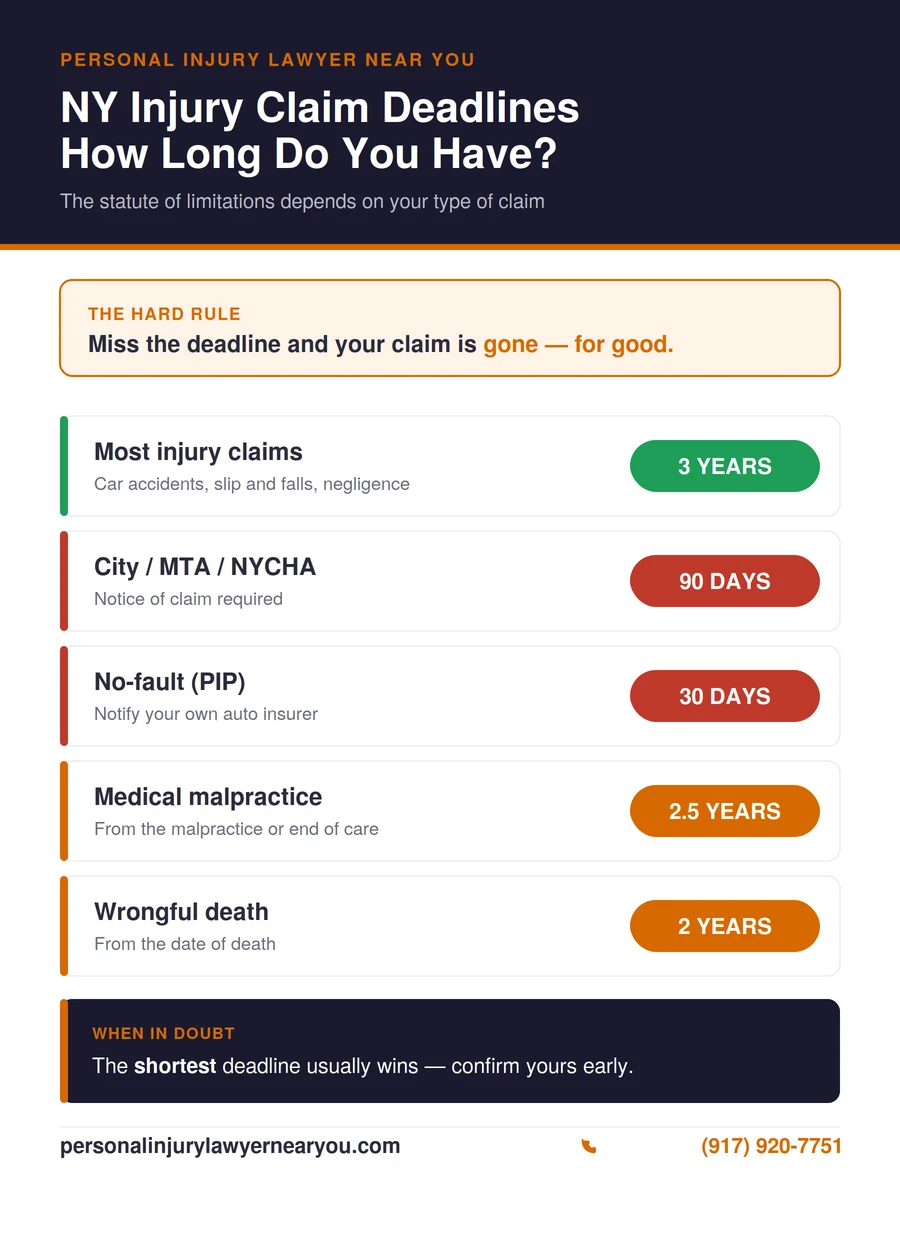
For most personal injury cases in New York — car accidents, slip and falls, and general negligence — you have three years from the date of the injury to file a lawsuit. This comes from New York’s Civil Practice Law and Rules (CPLR § 214).
Three years can feel like plenty of time, but it disappears fast while you’re focused on treatment and recovery. And the general rule is only the starting point — the deadline that actually applies to your case depends on who you’re suing and what kind of claim it is. If you were hurt in Brooklyn, a Brooklyn personal injury lawyer can confirm exactly which deadline governs your claim.
The 90-Day Trap — Claims Against the City, MTA, or NYCHA
This is where the most valid claims die. If your injury involved a government entity — the City of New York, the MTA, NYCHA public housing, a public hospital, or a city bus — you don’t get three years to start. Under New York’s General Municipal Law, you must file a formal notice of claim within 90 days of the accident, then file the lawsuit itself within one year and 90 days.
Ninety days goes by in the blink of an eye. A fall on a City-maintained sidewalk, a crash with an MTA bus, or an injury in a NYCHA building all trigger this short clock. Miss it, and the government can have your case dismissed no matter how badly you were hurt. If your fall happened on a public sidewalk, our guide to sidewalk slip and fall liability explains when the City is on the hook.
📄 Free PDF: NYC Notice of Claim Cheat Sheet
Our guide on how to file a notice of claim in NYC covers what the notice must say, the 50-h hearing and late notice, with a free three-page PDF showing where to file each notice.
Other Deadlines You Should Know
Several types of claims run on their own clocks, and some are much shorter than three years:
- Medical malpractice — generally two years and six months from the malpractice or the end of continuous treatment.
- Wrongful death — two years from the date of death (separate from the underlying injury deadline).
- Intentional acts like assault or battery — often just one year.
- No-fault (PIP) filing — you must notify your own auto insurer in writing within 30 days of a crash.
That 30-day no-fault deadline surprises almost everyone — you can read exactly how it works in our guide to New York no-fault insurance. Because these windows vary so much, the safest move is always to confirm your specific deadline early.
When the Clock Can Be Paused
In limited situations, New York law “tolls” — or pauses — the statute of limitations:
- Injured minors — the clock is often paused until the child turns 18, though special rules can still apply to government claims.
- Certain latent injuries — for some toxic or exposure-related harms, the clock may start when the injury is discovered rather than when it occurred.
- Legal incapacity — the deadline can be paused if the injured person is unable to manage their affairs.
These exceptions are narrow and fact-specific, and you should never assume one applies to your case without confirming it. A Manhattan personal injury lawyer can tell you quickly whether any tolling rule changes your deadline.
Why Waiting Costs You — Even With Time Left
Even when the statute of limitations hasn’t run, waiting quietly weakens your case. Surveillance and dashcam footage gets overwritten within days. Witnesses move and forget. Physical evidence gets repaired or thrown away. And gaps in your medical treatment give insurers an easy excuse to argue you weren’t really hurt.
The deadline is the outer limit — not the goal. The strongest claims are built in the days and weeks after the injury, not the months before the deadline. Understanding what your case may be worth early also helps; a free personal injury settlement calculator is a good place to start.
Key Takeaways
✅ Most New York personal injury claims have a 3-year statute of limitations
✅ Claims against the City, MTA, or NYCHA require a notice of claim within just 90 days
✅ Medical malpractice, wrongful death, and intentional torts run on shorter, separate clocks
✅ No-fault claims must be filed with your insurer within 30 days
✅ The clock can be paused for minors and some latent injuries — but never assume it applies
Frequently Asked Questions
How long do I have to file a personal injury claim in New York?
For most personal injury claims, New York’s statute of limitations is three years from the date of injury. However, claims against a government entity like the City, MTA, or NYCHA require a notice of claim within 90 days, and other claim types such as medical malpractice have shorter deadlines.
What is the deadline to sue the City of New York for an injury?
Claims against the City, MTA, NYCHA, or other public entities require you to file a formal notice of claim within 90 days of the accident, and then file the lawsuit within one year and 90 days. Missing the 90-day notice deadline can permanently bar your claim.
What happens if I miss the statute of limitations?
If you miss the deadline that applies to your claim, the court will almost always dismiss your case, and you lose the right to recover compensation no matter how strong your case was. This is why confirming your specific deadline early is so important.
Can the personal injury statute of limitations be extended?
In limited situations. The clock may be paused for injured minors until they turn 18, for certain latent injuries discovered later, or when the injured person is legally incapacitated. These exceptions are narrow and fact-specific, so you should confirm whether any applies to your case.
Is the deadline different for a car accident versus a slip and fall?
The general three-year rule applies to both car accidents and slip and falls against private parties. However, a car accident also has a 30-day no-fault filing requirement, and a slip and fall on public property can trigger the 90-day notice of claim deadline against the City.
Get a Free Case Review
Not sure how much time you have left? The deadline that applies to your case may be far shorter than you think — and once it passes, your claim is gone. Get a free, no-obligation case review today and find out exactly which deadline governs your claim while you still have time to act.
Don’t Let the Deadline Decide Your Case
Free case review. No win, no fee. No upfront cost.
