
TL;DR — Quick Summary
Searching for Allstate personal injury settlements or GEICO payouts rarely turns up real numbers, because settlements are private and depend on your injury, your losses and the policy limits. What you can know is how big auto insurers work: an adjuster on a tight process, claim-valuation software, an early offer, and pressure for a recorded statement. In New York, your own no-fault coverage pays first; Allstate or GEICO as the at-fault driver’s insurer pays pain and suffering only for a serious injury, and only up to the policy limit.
People look up Allstate personal injury settlements and GEICO injury payouts hoping for a figure to compare against an offer. There is no reliable public average. What does exist is a clear picture of how large auto insurers handle injury claims, and knowing that process is what protects the value of yours.
This guide covers who you deal with, how offers are built, the tactics to expect, and how to negotiate.
Which Claim Are You Making?
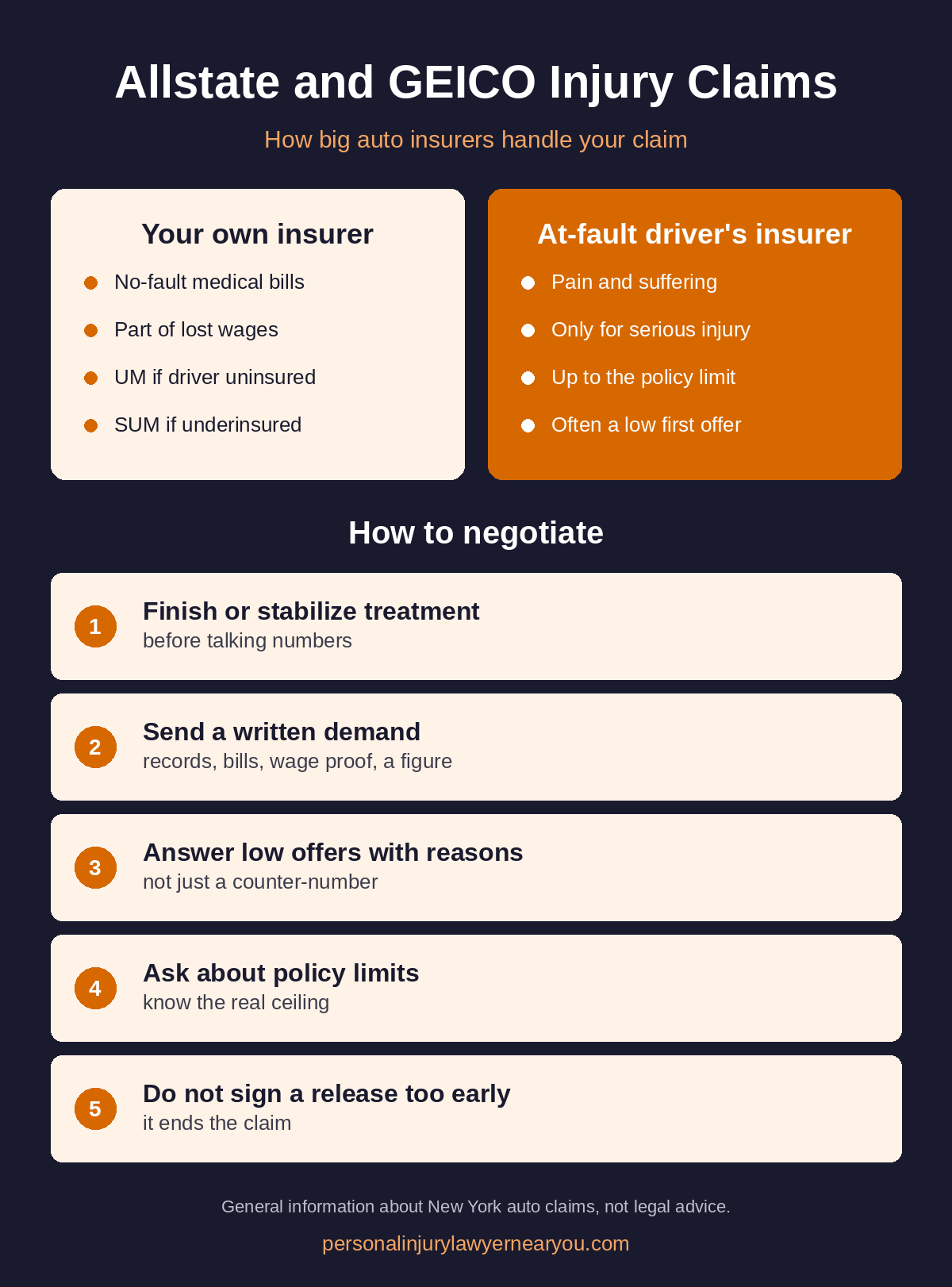
Your relationship with Allstate or GEICO depends on whose policy it is:
| Situation | What Allstate or GEICO pays |
|---|---|
| They insure you (your own policy) | No-fault benefits for medical bills and lost wages, and UM/SUM if the other driver is uninsured or underinsured |
| They insure the at-fault driver | Bodily injury liability for economic losses beyond no-fault, and for pain and suffering if your injury meets the serious injury threshold, up to the policy limit |
| They insure the car you were riding in | Often your no-fault benefits as a passenger |
In New York, the first layer is always no-fault. Our guide to who pays a personal injury claim after a car accident walks through every layer in order.
How Big Insurers Value an Injury Claim
Large auto insurers handle huge claim volumes, so they rely on standard processes. Adjusters enter diagnoses, treatment, time off work and other details into claim-valuation systems that suggest a settlement range. This is not a secret: in 2010, Allstate agreed to a $10 million multistate settlement after regulators reviewed how it used its Colossus bodily injury software, as Digital Insurance reported, although the review found no systemic underpayment.
The practical lesson is simple: the system can only count what is documented. Diagnoses, treatment, prescriptions and lost work that never reach the file do not add value.
Tactics to Expect From a Large Auto Insurer
| Tactic | What to do |
|---|---|
| A quick, low early offer | Do not accept until you know the full extent of your injuries |
| Requests for a recorded statement | You can decline with the other driver’s insurer; give facts in writing |
| Broad medical authorizations | Limit releases to records related to the accident |
| Arguing a pre-existing condition | Ask your doctor to explain what changed after the crash |
| Disputing gaps in treatment | Keep appointments and document any reason for delays |
| Slow responses | Follow up in writing and keep a log of every contact |
A recorded statement is the biggest risk for most people. You generally do not have to give one to the other driver’s insurer. Read what not to say to an insurance adjuster before you pick up the phone.
What Actually Drives Your Settlement
- The injury itself and whether it meets New York’s serious injury threshold for pain and suffering.
- Medical documentation, consistent and without long gaps.
- Lost income, proven with pay stubs and an employer letter.
- Fault, now critical in New York car cases after the 2026 change to comparative fault.
- Policy limits. New York’s minimum bodily injury coverage is $25,000 per person. If the at-fault driver carries only the minimum, your own SUM coverage may matter more than the negotiation.
To see how adjusters build a number, read how to calculate a car accident settlement in New York, and compare with average personal injury settlement amounts in New York.
How to Negotiate With Allstate or GEICO
- Finish or stabilize treatment before discussing numbers.
- Send a written demand with records, bills, wage proof and a specific figure.
- Answer low offers with reasons, pointing to documented losses, not just a counter-number.
- Ask about policy limits early, so you know the realistic ceiling.
- Do not sign a release until you are sure, because it ends the claim.
If talks stall, a complaint to the NY Department of Financial Services is an option for unfair handling, and a lawsuit is the main source of leverage. A Queens car accident lawyer or a lawyer in your borough can tell you whether the offer reflects the claim’s real value.
Frequently Asked Questions
What is the average Allstate personal injury settlement?
There is no reliable public average, because Allstate settlements are private and depend on the injury, the medical costs, lost income, fault and the policy limits. The same is true for GEICO.
Does Allstate use software to value injury claims?
Allstate has used a claims system called Colossus for bodily injury claims. In 2010 it agreed to a $10 million multistate settlement after regulators reviewed how it used the software, although the review found no systemic underpayment.
Should I give GEICO or Allstate a recorded statement?
If they insure the other driver, you are generally not required to give one, and it can be used to dispute fault or your injuries. If they insure you, your policy may require cooperation, so give accurate facts and avoid guessing.
Who pays first after a car accident in New York?
Your own no-fault coverage pays first for medical bills and part of your lost wages, up to $50,000. The at-fault driver’s insurer pays pain and suffering only if your injury meets the serious injury threshold.
How long does an Allstate or GEICO injury settlement take?
Simple claims can settle within a few months once treatment ends. Disputed or serious injury claims often take a year or more, especially if a lawsuit is needed.
Can I negotiate an Allstate settlement offer?
Yes. First offers are usually low. Respond in writing with medical records, bills and proof of lost income, and explain why the offer does not cover your documented losses.
Key Takeaways
✅ There is no reliable public average for Allstate or GEICO settlements
✅ Big insurers use standard processes and claim-valuation software
✅ Only documented losses add value to the claim
✅ Be careful with recorded statements and broad medical releases
✅ Policy limits often set the real ceiling on a New York settlement
Dealing With Allstate or GEICO After an Accident?
Large insurers handle thousands of claims and know exactly which ones to fight. A free case review tells you what your claim is likely worth, whether the policy limits are enough, and whether the offer on the table is fair.
Got an Offer From Allstate or GEICO? Check It First
Free case review. No win, no fee. No upfront cost.
Want more NYC injury guides and legal news from PILNY in your Google results?
