
TL;DR — Quick Summary
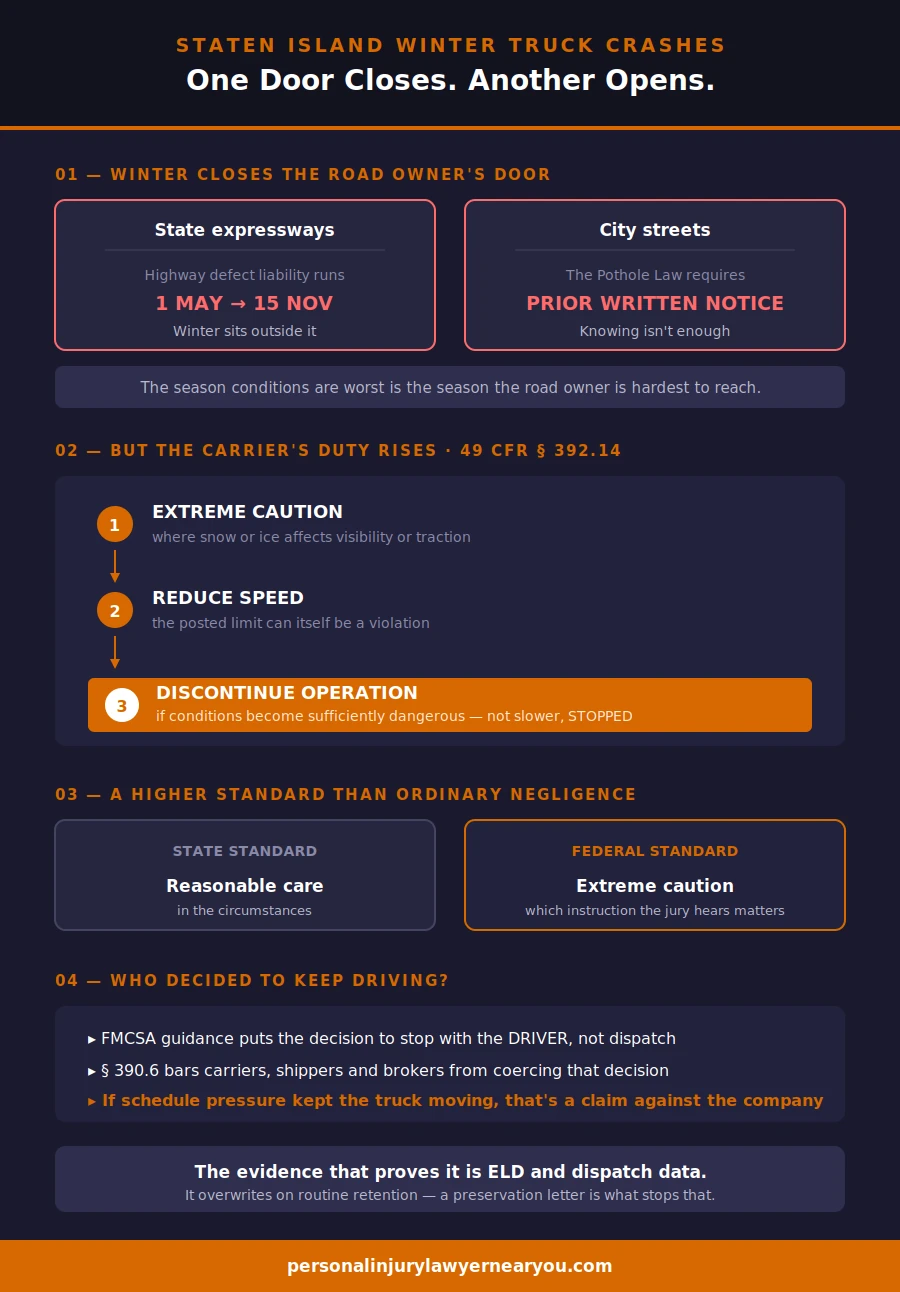
Winter does something strange to a Staten Island truck claim. The road owner becomes almost unreachable — State highway defect liability runs only from 1 May to 15 November, and a City street needs prior written notice. But the carrier’s standard rises. Under 49 CFR § 392.14 a commercial driver must exercise extreme caution in snow and ice, reduce speed, and — if conditions become sufficiently dangerous — stop driving altogether. Courts have held this federal standard is higher than ordinary negligence. So the season that closes one door opens another.
A Staten Island winter truck accident feels like the clearest case there is. Ice on the road, a heavy vehicle, a crash. Surely someone should have salted it.
That instinct points at the hardest defendant available, and away from the one whose duty actually went up that morning.
Winter Closes the Road Owner’s Door
This is the part nobody expects, and it applies across the island.
On the State expressways — the Staten Island Expressway and the West Shore — New York State’s own guidance on highway damage claims reflects that liability for defects in State highways runs between 1 May and 15 November. A defect-based claim arising in January sits outside that window. The mechanics of the State claim itself are covered in our post on Staten Island Expressway crashes.
On City streets like Hylan Boulevard, the Pothole Law requires prior written notice of the specific defect, and courts have held that actual or constructive knowledge by the City is not enough. That is covered in our post on why a City street is the hardest defendant on Staten Island.
Put those together and you get an uncomfortable result: the season when road conditions are worst is the season when the road owner is hardest to reach.
But the Carrier’s Standard Goes Up
Here is the counterweight, and it is a strong one.
49 CFR § 392.14 sets a specific federal duty for commercial vehicles in bad weather. It is not a suggestion and it is not the same as ordinary care:
| The duty | What § 392.14 requires | What it means in your case |
|---|---|---|
| Extreme caution | Required where snow, ice, sleet, fog, rain or dust adversely affect visibility or traction | A higher bar than “reasonable care” in the same conditions |
| Reduce speed | Speed “shall be reduced when such conditions exist” | Driving at the posted limit can itself be a violation |
| Stop entirely | If conditions become sufficiently dangerous, operation “shall be discontinued” and not resumed until the vehicle can be safely operated | The rule everyone forgets. Not slower — stopped |
That third row is the heart of a winter truck case. The regulation does not ask whether the driver was going carefully enough. It asks whether the vehicle should have been moving at all.
And this matters at trial. In at least one appellate decision, a court reversed where a jury had been instructed on the ordinary state negligence standard instead of the higher federal extreme-caution standard under § 392.14. Which standard the jury hears is not a technicality.
The Decision Belongs to the Driver — and That Cuts Both Ways
FMCSA guidance under § 392.14 is explicit that the driver is responsible for the safe operation of the vehicle and for the decision to cease operation because of hazardous conditions. Not dispatch. Not the customer waiting at the other end.
That assignment exists to protect drivers from being pushed. And 49 CFR § 390.6 reinforces it — motor carriers, shippers, receivers and transportation intermediaries are prohibited from coercing a driver to operate in violation of federal safety rules, and coercion complaints can be filed with FMCSA.
For an injured person this opens a second line of inquiry. If the driver kept going in conditions that called for stopping, the question becomes why — and if the answer lies in a delivery window, a dispatch instruction, or a penalty for arriving late, that is a claim against the company rather than the person behind the wheel. Delivery schedules, dispatch messages and telematics all speak to it, and none of them survive indefinitely.
Why Staten Island Is Genuinely Worse in Winter
This is not a generic winter-driving article. Staten Island has conditions the rest of New York City does not.
- Real elevation. The island has a genuine ridge running through its centre — sustained grades that a loaded truck has to climb and, more dangerously, descend. Flat Brooklyn and Queens streets do not produce that problem.
- Bridge decks freeze first. Every truck entering or leaving the island crosses one, and exposed spans ice before the roads leading to them.
- Wind over the water. The crossings are exposed, and a high-sided trailer in a crosswind on an icy deck is a different vehicle than it was ten minutes earlier.
- Total car dependence. Staten Island is the only borough without a subway, so in bad weather the roads carry traffic that elsewhere would go underground.
- Through freight does not stop. Most trucks crossing the island have neither origin nor destination there. They are passing through on a schedule set somewhere else.
If You Were on Foot
There is a third thread that comes up constantly on commercial strips: a pedestrian steps into the roadway because the pavement was never cleared, and is struck.
Administrative Code § 16-123 requires every owner, lessee, tenant or occupant of a building or lot abutting a paved sidewalk to remove snow and ice from the sidewalk and gutter within four hours after the snow ceases to fall — with the hours between 9 pm and 7 am excluded from that calculation.
Two refinements matter here. New York’s storm in progress doctrine means an owner is generally not liable for accumulation while a storm is still ongoing; the duty arises after a reasonable period once it stops. And there is a carve-out that applies specifically to this borough — owners of property abutting 500 feet or more of paved sidewalk in Staten Island or Queens may begin clearing within the four-hour window and complete the work within a reasonable time.
A violation of § 16-123 is evidence of negligence rather than negligence per se, but combined with § 7-210 it places a real duty on the abutting business — which on a Staten Island commercial strip is almost never an exempt small homeowner.
What to Preserve, and How Fast
| What to capture | Why it decides the case |
|---|---|
| Exactly when the snow stopped | Starts the four-hour clock and defeats or supports a storm-in-progress defence |
| Road surface photographs | Ice, slush and treatment disappear within hours |
| Whether the road had been salted | Goes to what conditions the driver actually faced |
| ELD and telematics data | Speed against conditions — the core of a § 392.14 claim |
| Dispatch messages and delivery windows | Whether the driver was pushed to keep moving |
| NWS records for that location | Independent proof of conditions and timing |
The fourth row is the one that wins these cases and the one that vanishes fastest. Telematics cycle out on ordinary retention schedules, and a preservation letter is what stops that. The wider sequence is in our guide on what to do after a truck accident in New York, and the deadlines by defendant are mapped in our guide to which authority owns the road you crashed on.
The Rules That Still Apply
You have 30 days to file your no-fault application. The serious injury threshold under Insurance Law § 5102(d) governs pain and suffering, and comparative negligence reduces recovery by your share of fault — with non-economic damages barred where your fault exceeds the defendants’ combined share under the 2026 reform. Expect an insurer in a winter case to lean hard on that, arguing everyone should have driven differently. Our free settlement calculator gives you a working range before any offer is discussed.
Frequently Asked Questions
Can I sue the City or State for failing to plough or salt the road?
It is difficult. On State expressways, New York’s guidance on highway damage claims reflects that liability for defects in State highways runs between 1 May and 15 November. On City streets the Pothole Law requires prior written notice of the specific defect, and actual or constructive knowledge by the City is not enough. Both routes are far harder in winter than a claim against the carrier.
What does 49 CFR § 392.14 require of truck drivers in snow?
Extreme caution where snow, ice, sleet, fog, mist, rain, dust or smoke adversely affect visibility or traction; reduced speed while those conditions exist; and, if conditions become sufficiently dangerous, that operation be discontinued and not resumed until the vehicle can be safely operated. The obligation to stop is the part most often overlooked.
Is the federal standard different from ordinary negligence?
Yes, and courts have treated the difference as significant. In at least one appellate decision a verdict was reversed because the jury had been instructed on the ordinary state negligence standard rather than the higher federal extreme-caution standard under § 392.14.
The driver said dispatch told him to keep going. Does that help?
It can. FMCSA guidance places the decision to cease operation with the driver, and 49 CFR § 390.6 prohibits carriers, shippers, receivers and intermediaries from coercing a driver to violate federal safety rules. Evidence that the company pushed the driver to continue supports a direct claim against the company rather than only vicarious liability for the driver.
How long does a property owner have to clear snow from the sidewalk?
Administrative Code § 16-123 requires removal within four hours after the snow ceases to fall, with the hours between 9 pm and 7 am excluded from that period. Owners of property abutting 500 feet or more of paved sidewalk in Staten Island or Queens may begin within the window and complete the work within a reasonable time.
What is the storm in progress doctrine?
It is the principle that a property owner is generally not liable for injuries caused by snow or ice accumulation while a storm is still ongoing, because immediate removal during active precipitation is not reasonable. The duty arises once an adequate period has passed after the storm ends, which is why establishing exactly when it stopped matters so much.
Key Takeaways
✅ State highway defect liability runs 1 May to 15 November — winter sits outside it
✅ City streets still require prior written notice of the exact defect
✅ § 392.14 requires extreme caution, reduced speed — and stopping when dangerous
✅ That federal standard is higher than ordinary negligence
✅ If dispatch pushed the driver to continue, that is a claim against the company
Build the Case Against the Right Defendant
In a winter crash the instinct is to blame the road, and the road is the one defendant the law has made hardest to reach. The carrier is the one whose obligations rose that morning — and the data proving whether they were met is sitting on a server that overwrites it. Speak to a Staten Island truck accident lawyer before it does. The framework is the same as any Staten Island personal injury claim, with a higher federal standard sitting underneath it. The case review is free, and there is no fee unless you win.
Talk to a Staten Island Truck Accident Lawyer Today
Free case review. No win, no fee. No upfront cost.
Want more NYC injury guides and legal news from PILNY in your Google results?
