
TL;DR — Quick Summary
Personal injury lawyers have a mixed reputation mainly because of aggressive advertising, the old “ambulance chaser” image, a minority of high-volume “settlement mill” firms, and clients who feel ignored or confused about fees. Most injury lawyers do valuable work: they take the financial risk of a case, often raise net recovery, and are paid only if you win. The key is learning to tell a good lawyer from a bad one before you sign.
Personal injury lawyer reputation is a strange thing. The same profession that people joke about on billboards is the one they call when an insurer refuses to pay for a broken leg. Both views have some truth in them, and understanding why helps you pick the right lawyer instead of avoiding help you actually need.
This guide looks honestly at why personal injury lawyers have a bad reputation, which complaints are fair and which are myths, and how to find a lawyer who earns their fee.
Why Do Personal Injury Lawyers Have a Bad Reputation?
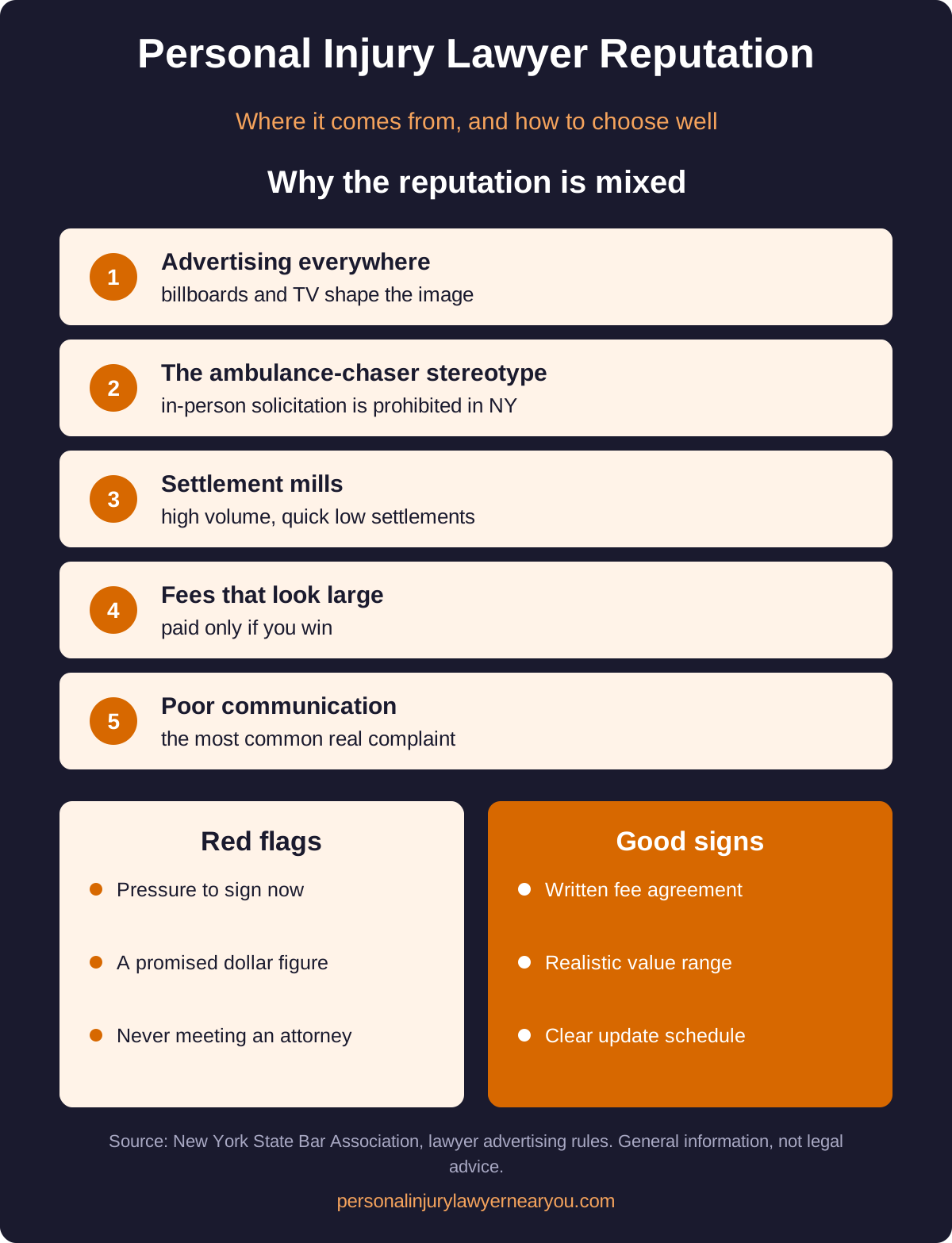
1. Advertising everywhere
Billboards, subway ads and late-night TV spots make injury law look like a sales business. Loud advertising doesn’t prove a lawyer is bad, but it shapes how the whole profession is seen, and it rarely tells you anything about how a case will actually be handled.
2. The “ambulance chaser” image
The stereotype comes from lawyers or their agents approaching accident victims at hospitals or crash scenes. That conduct is restricted: New York’s rules prohibit live, person-to-person solicitation for profit, as the New York State Bar Association explains in its summary of the advertising rules. The image has outlived most of the practice, but a few violators keep it alive.
3. Settlement mills
Some high-volume firms sign up as many cases as possible and settle them quickly for less than they’re worth, with clients rarely talking to an attorney. These firms do real damage to injured people and to the profession’s image. Our guide to what a settlement mill is shows how to recognize one.
4. Fees that look large
A one-third contingency fee on a large settlement can sound like a lot. What people don’t see is that the lawyer paid the case costs upfront, took the risk of earning nothing, and often worked on it for years. Our explanation of the contingency fee model shows how the numbers really work.
5. Poor communication
The most common real complaint isn’t about money at all. It’s about calls not returned, updates that never come and clients who don’t know what is happening with their case. This is the frustration that turns satisfied clients into bad reviews.
Is the Personal Injury Lawyer Reputation Fair? Complaints vs Myths
| Common belief | Reality |
|---|---|
| “They’re all ambulance chasers” | In-person solicitation for profit is prohibited; most clients come by referral or choice |
| “They take most of the money” | A typical NY fee is about a third, and only if they win |
| “They just want a quick settlement” | True of settlement mills; good lawyers push for full value |
| “Lawyers never call you back” | Sometimes fair; clients have a right to be kept informed |
| “You’d get the same without a lawyer” | Sometimes for small claims; rarely for serious injuries |
| “They file frivolous lawsuits” | Weak cases cost a contingency lawyer money, so most screen hard |
What Good Personal Injury Lawyers Actually Do
- Take the financial risk. They advance filing fees, records and expert costs, and lose them if the case fails.
- Level the field. Insurers have adjusters and defense lawyers; an injured person alone is negotiating against professionals.
- Value the whole claim. Future care, lost earning capacity and liens are easy for an individual to miss.
- Protect deadlines. Missing a 90-day notice of claim or the three-year limit can end a case permanently.
- Take cases to court when needed. The credible threat of trial is what moves insurers.
Red Flags of a Bad Personal Injury Lawyer
| Red flag | Why it matters |
|---|---|
| Pressure to sign at the first meeting | A good lawyer lets you take the agreement home |
| A promised dollar figure on day one | No one can value a case before records are reviewed |
| You never speak to an attorney | Common at settlement mills; your case gets less attention |
| No written fee agreement | New York requires contingency fee terms in writing |
| Pushing you to take the first offer | Early offers are usually low and come before treatment ends |
| Calls and emails go unanswered for weeks | A preview of how the whole case will feel |
A first meeting tells you a lot. Our guide to what to expect at a personal injury consultation in New York shows what a good one looks like.
What New York Requires of Injury Lawyers
Clients in New York have rights that address many of the complaints above. Contingency fee terms must be in writing, and the fee percentage and how expenses are deducted should be clear before you sign, as our breakdown of personal injury lawyer fees in New York explains. You are entitled to be kept reasonably informed about your case and to prompt replies to reasonable requests. The decision to settle is always yours, not the lawyer’s. And you can change lawyers if the relationship isn’t working.
Do Lawyers Really Increase Settlements?
For minor claims, not always. A lawyer’s fee can take more than the extra value they add. For serious injuries, disputed fault or claims against several defendants, a lawyer often increases the net amount in your pocket, because insurers value represented claims differently and lawyers know how to document future losses. The honest way to judge it is net recovery: what you would likely keep with a lawyer, after the fee, compared with what you would likely get alone.
Causes of Frustration With Personal Injury Legal Services After Crashes
Most frustration after a car crash comes from a mismatch between expectations and how claims really move. Cases take months or years, insurers delay, and the client is waiting for medical treatment to finish before the claim can be valued. If nobody explains that, silence feels like neglect. Liens and fees can also make the final check smaller than expected. A good lawyer explains the timeline, the fee and the likely deductions at the start, and keeps you updated as things change.
It also helps to know the slow periods are normal. While you are still treating, there is often little for a lawyer to do except collect records and wait, because settling before the injury is fully understood usually means settling for too little. A short check-in every few weeks, even to say nothing has changed, removes most of that frustration.
How to Find a Lawyer Who Lives Up to a Good Personal Injury Lawyer Reputation
Reputation is earned case by case. These steps help you find a lawyer who will treat you well.
Ask who will actually handle your case
At many firms, the person who signs you up isn’t the person who works your file. Ask which attorney is responsible and how often you’ll speak with them.
Get the fee agreement in writing
Make sure you understand the percentage, whether it changes if a lawsuit is filed, and how expenses are handled. New York requires a written contingency fee agreement.
Watch how they talk about value
A good lawyer gives a realistic range and explains it. A lawyer who promises a big number at the first meeting is selling, not advising.
Notice whether they pressure you
You should be able to take the agreement home and think about it. Pressure to sign on the spot is a warning sign, and so is a firm that won’t give you a copy of the agreement to review first.
Check their record
Look up the lawyer’s registration and any discipline with the New York courts, read reviews critically, and ask about cases like yours.
Ask how they’ll keep you updated
Agree on how often you’ll hear from the firm and how, whether by phone, email or a client portal. A lawyer who sets clear expectations on communication is far less likely to leave you guessing months later.
Use the consultation to interview them
A free consultation is your chance to judge them, not just the other way round. Bring a short list from our guide to the questions to ask a personal injury lawyer and pay attention to how clearly they answer.
Trust your instincts
If something feels off at the first meeting, it usually gets worse, not better. You are hiring someone to represent you for months or years, so comfort and trust count as much as credentials.
The overall personal injury lawyer reputation will probably always be mixed. Your own experience doesn’t have to be. Choosing carefully is the difference between a lawyer who earns their fee and one who doesn’t.
When You Might Not Need a Lawyer at All
Not every claim needs one. Minor injuries with clear fault and modest bills can sometimes be settled directly with the insurer. Our guide on how to find a personal injury lawyer after an accident also covers when it makes sense to start on your own and when to bring someone in.
Frequently Asked Questions
Why do personal injury lawyers have a bad reputation?
Mostly because of loud advertising, the old image of the ambulance chaser, a small number of high-volume firms that settle cases quickly and cheaply, and frustration when clients feel ignored. The contingency fee system is also widely misunderstood, which makes fees look larger than the work behind them.
Are personal injury lawyers ambulance chasers?
Most aren’t. In-person solicitation of accident victims for profit is prohibited under New York’s lawyer conduct rules, and most injury lawyers get clients through referrals and advertising. A few bad actors and pushy marketing created the stereotype.
How do I spot a bad personal injury lawyer?
Warning signs include pressure to sign immediately, promises of a specific dollar amount, never speaking to an actual attorney, slow or no replies, no written fee agreement, and pushing you to accept an early offer without explaining why.
Why are people frustrated with personal injury lawyers after a crash?
Common frustrations are poor communication, cases that move slowly, not understanding where the settlement money went, and feeling like a file number. Many of these come from mismatched expectations and can be avoided by asking the right questions before hiring.
Do personal injury lawyers take too big a share of the settlement?
A typical New York contingency fee is about a third, sometimes more if the case goes to trial, and the lawyer is paid nothing if you lose. Whether that’s fair depends on whether the lawyer increased your net recovery by more than the fee, which is often the case for serious injuries.
How can I check a personal injury lawyer’s reputation?
Check their registration and any public discipline with the New York courts’ attorney search, read reviews with a critical eye, ask how many similar cases they’ve handled and who will work on your file, and ask for the fee terms in writing before you sign.
Key Takeaways
✅ The bad reputation comes mostly from ads, old stereotypes, settlement mills and poor communication
✅ In-person solicitation of accident victims for profit is prohibited in New York
✅ Contingency fees are paid only if you win, and good lawyers often raise net recovery
✅ Poor communication is the most common real complaint, and you have a right to updates
✅ Ask who handles your case, get fees in writing and avoid anyone who pressures you
Looking for a Lawyer You Can Trust?
A free case review is a no-pressure way to get honest answers about your claim, the fee and the likely timeline, so you can decide for yourself.
Get Straight Answers About Your Case
Free case review. No win, no fee. No upfront cost.
Want more NYC injury guides and legal news from PILNY in your Google results?
