
TL;DR — Quick Summary
You probably have a personal injury case if four things are true: (1) someone else was at fault, (2) you were actually injured, (3) the injury caused real losses like medical bills or missed work, and (4) there is insurance or another way to pay. You also need to be within the deadline: in New York, usually three years, but as little as 90 days for a notice of claim against the City or another public body. Use the self-check below, then get a free review if the answers point to yes.
Do I have a personal injury case? It’s the first question almost everyone asks after an accident, usually while dealing with pain, bills and phone calls from an insurer. The good news is that you can get a fairly clear answer by working through a handful of questions about fault, injury, losses, insurance and timing.
This guide walks you through that self-check, shows the situations that usually do and don’t make a case, and explains what to do next. It focuses on New York rules, where deadlines and the no-fault system change the picture for car crashes.
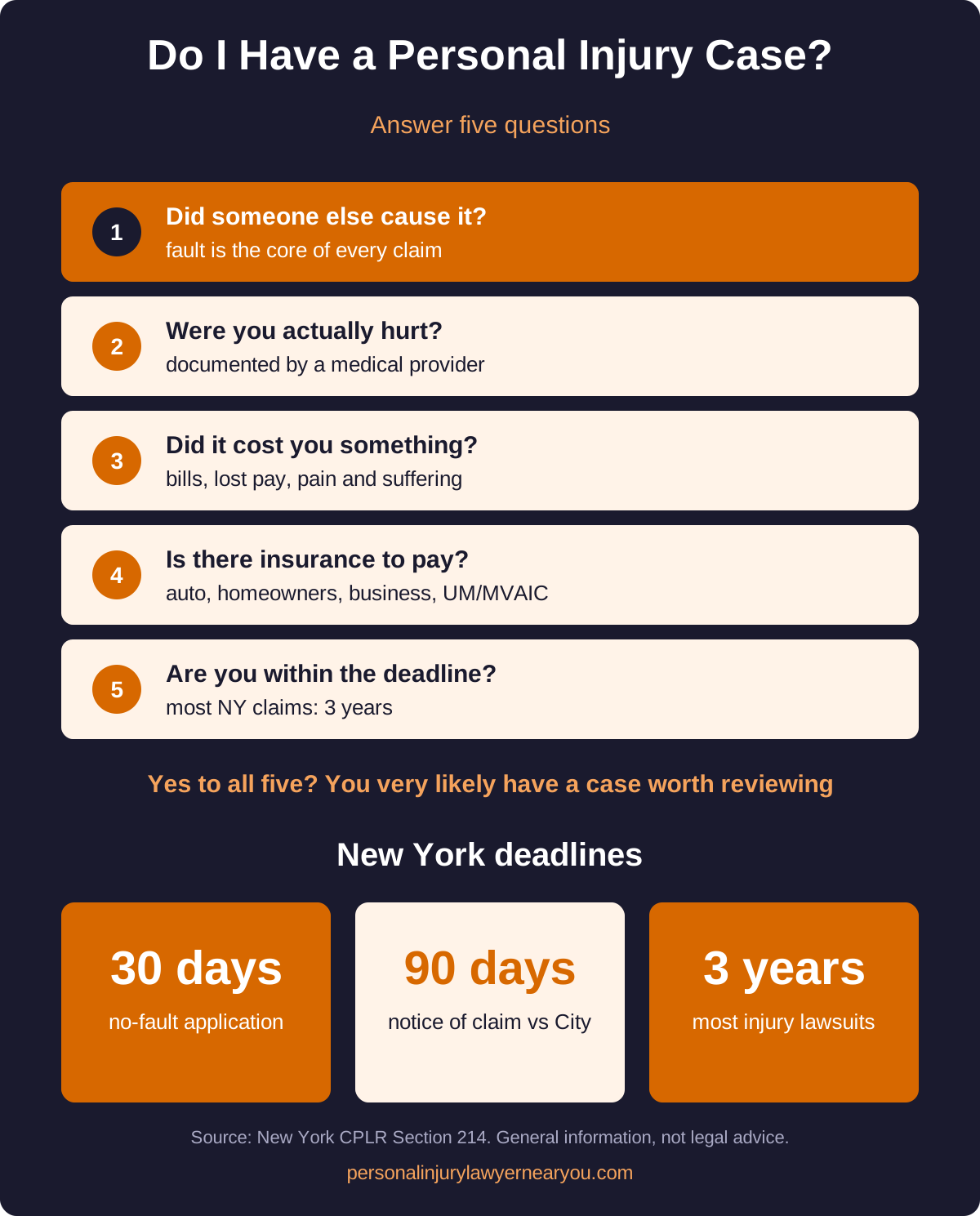
Do I Have a Personal Injury Case? The 5-Question Self-Check
| Question | If the answer is yes | If the answer is no |
|---|---|---|
| 1. Did someone else cause it? | Fault exists, which is the core of a claim | No one to claim against, usually no case |
| 2. Were you actually hurt? | There is an injury to compensate | Property damage only, not a PI case |
| 3. Did it cost you something? | Bills, lost pay, pain and suffering add value | Little to recover, even with clear fault |
| 4. Is there insurance or money to pay? | A claim can actually be collected | A win may be hard to collect |
| 5. Are you within the deadline? | You can still file | The claim may be barred for good |
If you answered yes to all five, you very likely have a case worth reviewing. If one answer is no, it doesn’t always end things, but it usually means the claim is smaller or harder.
Question 1: Was Someone Else at Fault?
Personal injury claims are built on negligence: someone failed to act with reasonable care, and that failure hurt you. A driver who ran a red light, a landlord who ignored a broken stair, a store that left a spill for hours. Fault doesn’t have to be 100% the other side’s. New York lets you recover even if you were partly to blame, though your share reduces what you receive.
Fault rules depend on the type of accident. On NYC sidewalks, for example, the abutting property owner is often responsible rather than the City, as our guide to who is liable for a sidewalk slip and fall in NYC explains.
Question 2: Were You Actually Injured?
You need a real physical or psychological injury, documented by a medical provider. Pain that shows up a day or two after a crash is common, so see a doctor even if you felt fine at the scene. In New York car accidents there is an extra step: to sue for pain and suffering, the injury must meet the “serious injury” threshold, such as a fracture or a permanent limitation. Our article on the serious injury threshold explains the categories after the 2026 changes.
Question 3: Did the Injury Cost You Something?
A case is worth what it can recover. The main categories are medical bills, lost income, future care and pain and suffering, all explained in our guide to personal injury damages in New York. A bruise that healed in a week with no treatment may be a real injury, but the claim will be small. Surgery, months of therapy or time off work make it much more significant.
Question 4: Is There Insurance or Another Way to Pay?
Most claims are paid by insurance: auto policies, homeowners or renters policies, business liability policies, or malpractice coverage. If the at-fault driver has no insurance, New York car crash victims may still recover through their own uninsured motorist coverage or MVAIC, as covered in our guide to being hit by an uninsured driver in NYC. A claim against someone with no insurance and no assets can be hard to collect even if you win.
Question 5: Are You Still Within the Deadline?
Under New York CPLR Section 214, most personal injury lawsuits must be filed within three years. But some claims run on much shorter clocks:
| Situation | Typical New York deadline |
|---|---|
| Car crash, slip and fall, dog bite (private defendant) | 3 years to sue |
| No-fault application after a car crash | 30 days |
| Claim against the City, NYCHA or the MTA | Notice of claim within 90 days |
| Medical malpractice | 2 years and 6 months |
| Wrongful death | 2 years from death |
Our full guide to the personal injury statute of limitations in New York covers exceptions such as injuries to children.
Situations That Usually Do and Don’t Make a Case
| Usually a case | Usually not a case |
|---|---|
| Rear-ended at a red light and needed surgery | Minor fender-bender with no injury |
| Fell on an unrepaired broken stair in your building | Tripped over your own bag at home |
| Bitten by a neighbor’s dog with a history of aggression | Bruised while playing a sport you chose |
| Hit by a delivery truck while crossing in the crosswalk | Hurt in a crash you clearly caused yourself |
| Injured by a product that failed in normal use | Short-lived soreness with no treatment or costs |
Special Situations That Change the Answer
You were partly at fault
Shared fault is common, especially in intersection crashes and falls. New York still lets you recover, reduced by your percentage of fault. After the 2026 reforms, though, a claimant whose fault is greater than the defendants’ combined share can lose the right to pain and suffering, so the exact split matters more than it used to.
You had an injury before the accident
A pre-existing condition doesn’t disqualify you. If the accident made an old back or knee problem worse, you can recover for that aggravation. Be upfront about it; hiding it is what damages credibility.
You were hurt at work
Workers’ compensation usually covers injuries on the job, and you generally can’t sue your own employer. But if someone else caused the injury, such as another driver, a property owner or an equipment maker, you may have a separate personal injury case against them as well.
The injury showed up later
Concussions, back injuries and some psychological injuries can take days or weeks to become clear. A delayed diagnosis doesn’t end a case, but you’ll need medical records that link the injury to the accident.
How a Lawyer Evaluates Your Case
At a free consultation, a lawyer looks at the same five questions, but with experience of how insurers and juries respond. They weigh how strong the evidence of fault is, how well the injury is documented, how much insurance is available and whether any deadline is close. If the case is small, a good lawyer will tell you, and may suggest handling it yourself. If it’s strong, they will explain the likely value range and the next steps.
Do I Have a Personal Injury Case Worth Pursuing? What to Do Next
Answering the five questions tells you whether a case exists. These steps help you protect it and decide what to do with it.
Get medical care and keep going
Treatment protects your health and creates the record your claim depends on. Gaps in care are one of the first things insurers use to argue an injury isn’t serious.
Gather evidence now
Take photos, write down what happened while you remember it, collect witness names and keep every bill and receipt. Ask a store or landlord for an incident report. Video from nearby cameras is often deleted within days, so ask businesses near the scene to keep any footage that may show the accident.
Be careful with the insurer
You can report the accident, but avoid recorded statements and don’t sign anything until you understand it. Early offers are usually low and come before the full extent of an injury is known.
Decide whether you need a lawyer
Small, clear claims can sometimes be handled directly, as our guide to a personal injury claim without a lawyer explains. Surgery, disputed fault, a government defendant or an injury that keeps you off work for weeks usually justify a free consultation, which costs nothing and doesn’t commit you to anything.
Keep a simple injury diary
Write a few lines each day about pain, sleep, missed plans and work. It takes minutes, and months later it is often the clearest record of how the injury affected your life, which is exactly what pain and suffering is meant to compensate.
Don’t wait on the deadline
Even if you are still treating, the clock is running. For claims against public bodies, the 90-day notice period can pass before you realize it matters.
So, do I have a personal injury case? If someone else caused a real injury that cost you money, there is insurance to pay it, and you are within the deadline, the answer is very likely yes. The next step is getting the details reviewed before evidence and deadlines slip away.
Frequently Asked Questions
How do I know if I have a personal injury case?
You likely have a case if someone else’s carelessness caused your injury, the injury led to real losses such as medical bills or missed work, there is insurance or another source of payment, and you are still within the filing deadline. If any of those is missing, the case is much weaker.
Do I have a case for personal injury if I was partly at fault?
Often, yes. New York lets you recover even if you were partly to blame, but your compensation is reduced by your share of fault. Recent reforms also limit some damages when an injured person’s fault is greater than the defendants’ combined share, so it’s worth getting advice early.
Is it worth pursuing a personal injury case for a minor injury?
Sometimes. If the injury healed quickly and the costs were small, a direct claim with the insurer may be enough. If you needed ongoing treatment, missed work, or the insurer is offering less than your bills, a free case review can tell you whether a lawyer would add value.
What evidence do I need for a personal injury case?
Useful evidence includes medical records and bills, photos of the scene and your injuries, a police or incident report, witness names, proof of lost wages, and any insurance correspondence. The sooner you collect it, the better, because video and memories disappear quickly.
How long do I have to file a personal injury case in New York?
Most New York personal injury lawsuits must be filed within three years of the injury. Claims against a city or other public body usually require a notice of claim within 90 days, and medical malpractice and wrongful death have different deadlines.
Can I have a personal injury case without a police report?
Yes. A police report helps but isn’t required. Medical records, photos, witnesses, video and an incident report from a store or landlord can also prove what happened, especially in slip and fall and other non-vehicle cases.
Key Takeaways
✅ A personal injury case needs fault, a real injury, real losses and a way to pay
✅ Partial fault doesn’t always end a claim in New York, but it reduces it
✅ Car crash claims for pain and suffering must meet the serious injury threshold
✅ Most NY lawsuits must be filed within three years; public bodies need notice in 90 days
✅ Treat early, collect evidence and avoid recorded statements to protect a claim
Still Not Sure If You Have a Case?
A free case review takes a few minutes and gives you a straight answer about fault, deadlines and what your claim could be worth, with no obligation.
Find Out If You Have a Case: Free Review
Free case review. No win, no fee. No upfront cost.
Want more NYC injury guides and legal news from PILNY in your Google results?
